
- Event Name
- Bisket Jatra In Tigani - Nil Barahi Jatra
- Duration
- 6 days
- Location
- Bhaktapur, Tigani, Tigani/Teegani belongs to the wider Madhyapur Thimi Biska geography. Nil Barahi Temple stands in the northern part of historic Tigani as an open-air shrine, and the goddess's palanquin joins Madhyapur Thimi's Sindoor Jatra.
- Category
- Kathmandu Valley Jatra
- Tradition
- Tigani Biska, Teegani Biska, Ni Ta Wane Gu, Nitya Puja, Four Thakuli, old and new Pamo groups, Gunshi Chwaykegu, Shree Nilbarahi Mu Dhime Khala, Sunga taal, Chhoila Bhu, Baniisiya Jatra, Nhiisiya Jatra, Mu Jatra, Nil Barahi palanquin, open-air Nil Barahi Temple, Dyo Chhen image, khat carried on shoulders, goja, Nritya Puja, Sinha, Gyankha/Gyakhe, Taratol, Nagdesh Sanchwa, Siddhi Ganesh union, Chiba Dyo, Kshema Puja, Tadhha Tole, Thwo prasad
Bisket Jatra In Tigani - Nil Barahi Jatra Day-by-Day Schedule for 2026 (2082-2083 BS)
| Day | Date | Ritual / Event | Highlights & Notes |
|---|---|---|---|
Day 1 | Friday | April 10, 2026 Krishna Ashtami | Chaitra 27, 2082 BS | Ni Ta Wane Gu At Nil Barahi | The Four Thakuli and old and new Pamo groups begin the Tigani Nil Barahi service with Nitya Puja at the goddess's shrine. |
Day 4 | Monday | April 13, 2026 Krishna Ekadashi | Chaitra 30, 2082 BS | Gunshi Chwaykegu | Nil Barahi is prepared for the palanquin through worship, bathing, ornamenting, Dhime group escort, samay tradition, Chhoila Bhu, bhoj, bhajan, and night vigil. |
Day 5 | Tuesday | April 14, 2026 Krishna Dwadashi | Vaishakha 1, 2083 BS | Baniisiya Jatra | Devotees take darshan of Nil Barahi on the palanquin. Goja, Nritya Puja, Sinha, the town route, and the khat resting at Taratol shape the day. |
Day 6 | Wednesday | April 15, 2026 Krishna Trayodashi | Vaishakha 2, 2083 BS | Nhiisiya Jatra / Mu Jatra | Nil Barahi's khat moves through Tigani and toward Nagdesh Sanchwa, where the goddess awaits Siddhi Ganesh. The day closes through Chiba Dyo, Kshema Puja, and return to the Dyo Chhen. |



Bisket Jatra In Tigani – Nil Barahi Jatra in Photo Gallery
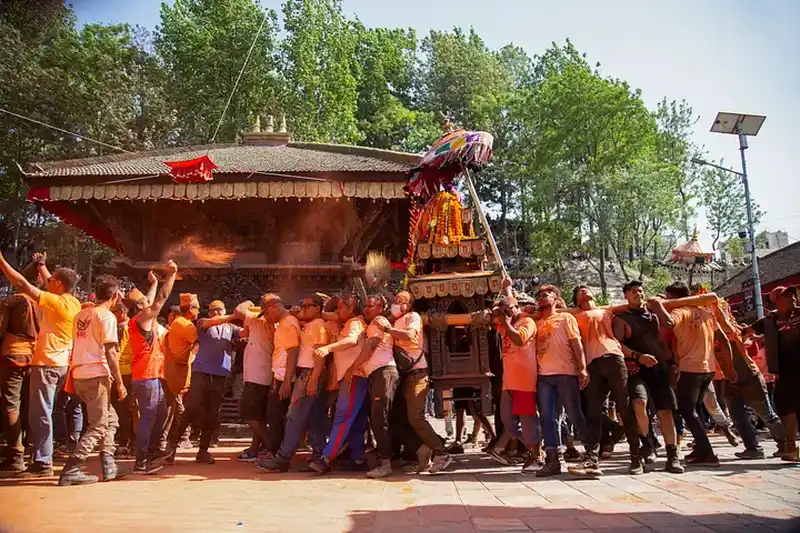
Tigani jatra works at neighborhood scale beside Thimi’s main Sindoor Jatra. Local youth bring the jatra to life by carrying the khat on their shoulder.
Bisket Jatra in Tigani (Teegani) is the local Nil Barahi part of the wider Madhyapur Thimi Biska tradition.
It begins inside its own neighborhood before feeding into the larger Thimi-side New Year celebration, so the jatra has to be understood through movement: Nil Barahi worship starts at the goddess’s own shrine, passes through Ni Ta Wane Gu and Gunshi Chwaykegu, enters Baniisiya and Nhiisiya Jatra, and then carries the goddess toward the wider Madhyapur Thimi Biska gathering.
Tigani is one part of the larger Biska system of the old Bhaktapur kingdom, where different settlements bring their own deities, khats, musicians, and devotees into the New Year cycle.
It is smaller in scale than Bhaktapur or central Thimi, but Nil Barahi stands at the fierce goddess center of the settlement, and the shoulder-carried khat gives Tigani a different life from the pulled chariots of Bhaktapur.
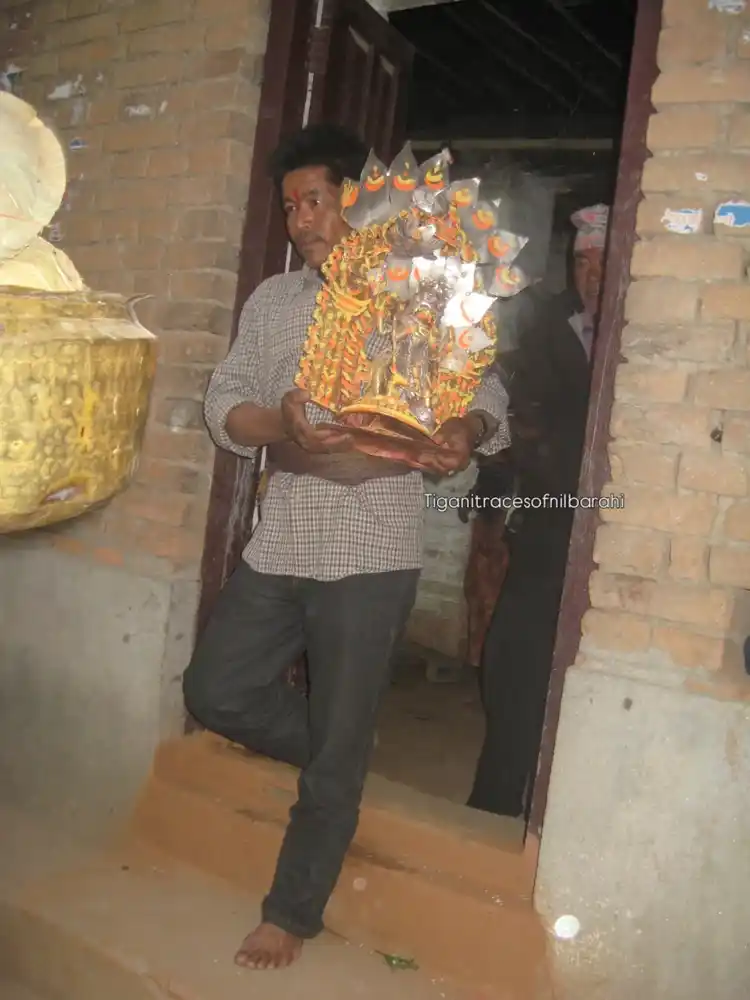
Tigani’s Bisket Jatra belongs to the local khat tradition of Madhyapur Thimi and centers on Nil Barahi.
In the wider Thimi Biska world, different neighborhoods bring out deity khats and join the collective Sindoor Jatra.
The main Thimi core gathers many khats around Balkumari, while nearby settlements such as Bode, Nagadesh, and Tigani keep their own local pride and deity worship inside the same New Year season.
Tigani works at neighborhood scale beside Thimi’s main Sindoor Jatra.
Yet, the Tigani’s role carries weight because the settlement brings Nil Barahi from the edge of the wider Thimi area toward the larger Biska gathering. Local youth, guthi members, musicians, elders, and families all take part in representing Tigani, and their pride gathers around the goddess rather than around crowd size.
Nil Barahi is not a light decorative presence in this jatra.
Barahi belongs to the fierce mother-goddess tradition, and Tigani remembers her as a protector of the place.
When the khat comes out, it carries a goddess whose worship asks for protection, strength, and the wellbeing of the settlement.
That is why Tigani’s Biska can feel powerful even at local scale: a smaller community bears a powerful deity along its own old route before entering the wider Madhyapur Biska season.
Tigani’s Biska happens around the Nepali New Year period, especially from Chaitra 27 through Baisakh 2.
Local tradition begins earlier at Nil Barahi Temple, where the Four Thakuli and the old and new Pamo groups perform Ni Ta Wane Gu, also understood as Nitya Puja, on Chaitra 27.
That pre-jatra worship prepares the Nil Barahi side of the festival before the New Year khat movement begins.
On Chaitra 30, Tigani observes Gunshi Chwaykegu. Devotees prepare the deity for the palanquin, bathe and ornament the Nil Barahi image, and carry the devotion toward the main Biska days through the guthi and Dhime groups.
After that preparation, the jatra turns outward: Baisakh 1 brings Baniisiya Jatra inside Tigani, while Baisakh 2 carries Nil Barahi toward Nagdesh Sanchwa and the wider Madhyapur gathering.
The local khat movement begins within Tigani before joining the wider Madhyapur Thimi Biska flow, and visitors usually follow local updates for that year’s route and timing.
Tigani works like a tributary inside the wider Madhyapur Thimi Biska system.
For the first part of the jatra, the devotion stays close to the neighborhood. The khat, guthi members, and local residents gather around Nil Barahi’s sacred presence.
Then the jatra moves beyond its neighborhood boundary as Tigani’s khat and devotees join the wider Thimi-side Biska movement, where the old core, Balkumari area, Nagadesh, Bode, and other settlement traditions meet in the New Year season.
Because Tigani sits toward the northern side of the Madhyapur Thimi area, Nil Barahi’s worship comes from that local edge into the common New Year flow, and when the khat moves towards Thimi, it carries Tigani’s neighborhood presence into the larger sacred gathering.
Local youth bring the jatra to life by carrying the khat on their shoulder. They move step by step, with music and community pride around them, so the devotion rests directly on their bodies.
Nil Barahi gives Tigani Biska its sacred center.
Her temple stands in the northern part of historic Tigani and is remembered for its open-air form.
The shrine has no roof. A natural stone represents the goddess at the temple. And, the jatra image of Nil Barahi stays at the Dyo Chhen until it comes out for the palanquin.
Local tradition connects the temple with Tantric establishment under King Vikram Sen. The goddess’s three-eyed, four-handed form carries a fierce protective presence rather than a gentle household image.
Because of this, Tigani Biska holds two sacred presences together.
The natural stone keeps Nil Barahi rooted at the open-air temple, while the Dyo Chhen image lets the goddess travel through the settlement during the jatra.
When Tigani carries Nil Barahi, the procession brings the moving form of a fierce local protective goddess into the New Year streets, while her open-air shrine remains the sacred ground behind the route.
The open-air temple also ties the jatra to land and edge.
Nil Barahi belongs to shrine space, the forest side of Tigani, Dyo Chhen, khat, music, and the route that takes her toward Nagdesh Sanchwa. Once that path is clear, the many local terms begin to fit together: Ni Ta Wane Gu begins the service at the goddess’s shrine, Gunshi Chwaykegu prepares the image and palanquin, Baniisiya Jatra brings Nil Barahi through Tigani, and Nhiisiya or Mu Jatra carries her toward the meeting with Siddhi Ganesh.
Ni Ta Wane Gu At Nil Barahi
Tigani’s Biska devotion begins before the main New Year khat movement.
On Chaitra 27, the Four Thakuli and both the old and new Pamo groups gather at Nil Barahi Temple for Ni Ta Wane Gu.
Because this Nitya Puja happens before the larger Biska crowd gathers, Tigani’s public jatra begins quietly at the goddess’s own shrine.
Before crowds, sindoor, and the wider Madhyapur movement, the Four Thakuli and Pamo groups begin with service to the goddess.
Gunshi Chwaykegu On Chaitra 30
On Chaitra 30, Tigani prepares Nil Barahi for the palanquin through Gunshi Chwaykegu.
The ritual act of bringing firewood from the Nilbarahi forest for burning begins.
After members of Shree Nilbarahi Mu Dhime Khala worship Nilbarahi Mai and share samay baji, the day moves toward preparing the goddess herself. Later, the idol receives a bath and ornaments, and the Thakuli and Pamo of the Nilbarahi Dyo Guthi carry the decorated image, puja items, and offerings to Nil Barahi Temple for Nitya Puja.
After worship, the image rests near the falcha on the left side while the samay tradition continues.
And, when the Dhime Guthi arrives in procession to escort the deity, the sacred image moves only after the Nilbarahi Dyo Guthi offers refreshments to the Dhime Guthi.
On this day, a guthi member carries the image instead of placing it directly on the palanquin, while the dhime plays the special Sunga taal.
Once the deity reaches the palanquin, Chhoila Bhu begins only after Tigani residents offer batti, and the night continues with bhoj, bhajan, and jagaran.
People stay awake with food, light offerings, music, and the presence of Nil Barahi on the palanquin.
Baniisiya Jatra, then, begins the next day from a goddess already prepared through worship and vigil.
Baniisiya Jatra On Baisakh 1
Baisakh 1 brings Baniisiya Jatra.
Devotees come for darshan of Nil Barahi seated on the palanquin, while many households offer chicken or goat as ritual sacrifice before Nakha Bhoj.
Throughout the day, the image of Nil Barahi receives decoration and ornaments.
As the four Pamo and Thakuli carry seven large ritual items, called goja, toward Nil Barahi Temple, they perform Nritya Puja before the khat comes out.
After Nitya Puja, the four Thakuli sit on the left side of the khat and make ceremonial offerings, and the jatra formally begins only after Sanu Kaji Rajbahak applies vermilion powder, called Sinha.
From there, the procession returns through Gyankha, also called Gyakhe. Gyankha is the historic starting point of Nilbarahi Dyo Pyakhan. Then the deity circles the town before Nil Barahi’s palanquin rests at Taratol.
Because each name marks a part of the goddess’s movement, Baniisiya stays inside Tigani’s own ritual life rather than becoming a general New Year Biska festival.
Goja, Nritya Puja, Sinha, Gyankha, Nilbarahi Dyo Pyakhan, and Taratol all show how Pamo, Thakuli, Dhime groups, households, and local devotees enter the day through different duties while Nil Barahi remains at the center.
Nhiisiya Jatra And Mu Jatra On Baisakh 2
Baisakh 2 brings Nhiisiya Jatra, also called Mu Jatra.
By this day, Nil Barahi has already been worshipped, bathed, ornamented, placed on the palanquin, watched through the night, and taken through Tigani.
Nhiisiya Jatra carries that devotion farther.
Dhime groups, puja groups, and bhajan groups come together around the khat, and as the procession first moves through the town, Tigani receives the goddess in its own lanes before she is taken toward the wider Thimi Biska route.
After the circumambulation, the procession goes to Nagdesh Sanchwa, where Nil Barahi awaits Siddhi Ganesh during Biska Jatra.
The meeting remembers the union of Siddhi Ganesh and Nil Barahi, and as devotees pray for prosperity and success, Tigani’s Nil Barahi joins the larger Nagadesh and Madhyapur Thimi Biska season with her own name and route intact.
Older local history says Nil Barahi’s annual palanquin route once continued far beyond the immediate neighborhood.
According to the legends, on the return from Nagdesh, the deity passed through Bode, Samathali or Sarasamathali, Nikoshera, and Bhaktapur Durbar Square, with devotees receiving paddy, rice, and offerings along the way. Some memories carry the route even toward the fields of Kadaghari and Gothatar.
Nil Barahi is remembered as a goddess who could travel through fields, settlements, and offering routes before returning home.
After the full circumambulation, devotees immerse the deities at Chiba Dyo in the southern part of the area.
Achaju Bajracharya performs Kshema Puja, and the jatra closes joyfully in front of the Dyo Chhen at Tadhha Tole with the special Sunga taal from the Dhime group.
Once Nil Barahi goes inside the Dyo Chhen, the Dhime group visits the house of the local Pama, Sanu Kaji Rajbahak, receives Thwo as prasad, and then completes the celebration by visiting the house assigned for the Dhime Guthi’s turn.
The goddess has travelled outward, but the ending brings the jatra back to Tigani’s people, houses, and local order.
Nil Barahi Khat Worship
Tigani’s jatra is easiest to recognize through the Nil Barahi khat because the goddess travels on the shoulders of local youth rather than on a large wheeled chariot.
In Bhaktapur, people pull great chariots with ropes, while in Tigani the weight sits on human shoulders as the carriers stand close to one another, adjust their steps, listen to the music, and keep the khat steady above them.
In Newar jatra life, a khat is more than a festival object because it carries the deity’s presence into the streets, giving the neighborhood darshan close to home.
For the carriers, this is more than physical strength: they are holding the goddess for the settlement, and their shoulders support Nil Barahi’s journey from Dyo Chhen to street, from street to meeting place, and then back toward home.
Families and neighbors watch that effort closely because they know the khat is heavy, the route takes discipline, and the carriers represent Tigani in front of nearby Biska communities.
Even at neighborhood scale, Tigani enters the Biska season with force because its people carry their deity themselves, joining the open-air shrine, the Dyo Chhen image, and the public route through their own bodies.
Joining The Wider Biska Flow
Tigani’s jatra gains its wider meaning when it joins the Madhyapur Thimi Biska movement.
The distance from Tigani to the larger Thimi-side gathering makes the carrying more than a short neighborhood round. Because, the young men carry Nil Barahi’s presence across a greater distance before joining the wider Sindoor Jatra atmosphere.
As the khat reaches the wider Biska world, people see the goddess arrive with the discipline of the carriers and the music groups around them.
Sindoor And Neighborhood Pride
When Tigani joins the wider Thimi Biska, the local procession enters the shared world of sindoor, music, crowd movement, and New Year greeting.
Tigani arrives with its own people, its own rhythm, and its own pride, then joins the larger Biska family.
Sindoor adds public New Year joy, but the older Nil Barahi sequence remains the center, with the goddess, the Dyo Chhen image, the shoulder-carried khat, the rituals, and the route toward Nagdesh Sanchwa still holding Tigani’s place in the festival.
Nil Barahi gives Tigani its main sacred reference point.
The wider Madhyapur Thimi Biska geography also connects Tigani with Balkumari in Thimi, Bode’s sacred landscape, Nagadesh’s Siddhi Ganesh tradition, and other local khat routes around the municipality.
For the Tigani-side route itself, Nil Barahi Temple, the Dyo Chhen, Nagdesh Sanchwa, Chiba Dyo, and Tadhha Tole show the jatra moving from shrine and image, through town procession, into deity meeting, immersion, Kshema Puja, and return.
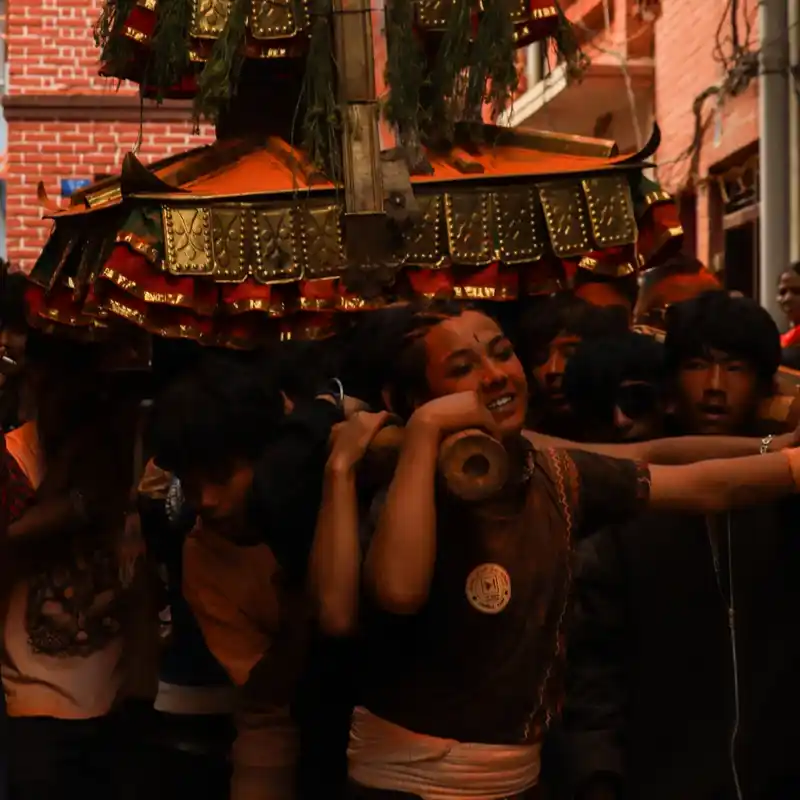
Yatris usually see a neighborhood-scale jatra rather than a large destination event.
The main experience is Nil Barahi’s khat on the shoulders of local youth, moving with Dhime music, Sunga taal, Baniisiya Jatra, Nhiisiya Jatra, sindoor from the wider Thimi Biska atmosphere, and families watching from streets and courtyards.
If you follow Tigani closely, the local ritual names begin to connect.
Ni Ta Wane Gu, Gunshi Chwaykegu, Baniisiya Jatra, Nhiisiya Jatra, Four Thakuli, Pamo groups, Dyo Guthi, Dyo Chhen, Sinha, Sunga taal, Chhoila Bhu, Nakha Bhoj, and Thwo all belong to the same local chain of devotion, while quieter moments such as the night vigil, the application of Sinha, the khat resting at Taratol, the meeting at Nagdesh Sanchwa, and the return to Dyo Chhen carry the jatra beyond the crowd.
Plan Tigani together with Madhyapur Thimi rather than as a standalone full-day destination.
If you want to see Tigani’s own local rites, follow Tigani community updates for Chaitra 30, Baisakh 1, and Baisakh 2.
If you want the larger Biska atmosphere, connect Tigani with the Thimi/Balkumari and Nagadesh side of the jatra.
Respect deity carriers, guthi members, musicians, and families offering worship. In neighborhood jatras, local guidance is more reliable than navigation apps.
What is Bisket Jatra in Tigani?
Bisket Jatra in Tigani is a local Madhyapur Thimi Biska observance centered on Nil Barahi. It includes Ni Ta Wane Gu, Gunshi Chwaykegu, Baniisiya Jatra, Nhiisiya Jatra, and the goddess’s khat carried by local youth before joining the wider Thimi-side New Year jatra.
Is Tigani Bisket Jatra separate from Bhaktapur Biska Jatra?
Tigani belongs to the wider Biska tradition of the old Bhaktapur kingdom, but it works through the Madhyapur Thimi side of the festival. It is better understood with Thimi, Bode, and Nagadesh than as a copy of Bhaktapur’s large Bhairavnath chariot jatra.
What deity is connected with Tigani Bisket Jatra?
Tigani’s Biska identity centers on Nil Barahi. The open-air temple stands in historic Tigani, and a special image of the goddess stays at the Dyo Chhen for the Sindoor Jatra palanquin.
Why is Nil Barahi Temple unusual?
Nil Barahi Temple in Tigani is remembered as an open-air shrine without a roof. A natural stone represents the goddess at the temple, while the image used for the jatra stays at the Dyo Chhen and comes out for the palanquin.
Do people pull or carry Tigani’s chariot?
In Tigani, local youth carry the Nil Barahi khat on their shoulders. The devotion sits directly on the carriers rather than on a large wheeled chariot pulled through the street.
What happens at Nagdesh Sanchwa?
During Nhiisiya or Mu Jatra, Tigani’s Nil Barahi procession reaches Nagdesh Sanchwa, where the goddess awaits Siddhi Ganesh. The meeting remembers the relationship between Nil Barahi and Siddhi Ganesh inside the wider Madhyapur Biska season.
When does Tigani Bisket Jatra happen?
It belongs to the Nepali New Year Biska period. Tigani’s Nil Barahi-side worship begins with Ni Ta Wane Gu on Chaitra 27, continues with Gunshi Chwaykegu on Chaitra 30, and moves through Baniisiya Jatra on Baisakh 1 and Nhiisiya or Mu Jatra on Baisakh 2.
Is Tigani enough for a full Biska visit?
Most visitors will understand Tigani better as part of a wider Madhyapur Thimi Biska visit. Combine it with Thimi’s Sindoor Jatra, Balkumari, Bode, or Nagadesh, depending on the current year’s route and local guidance.