
- Event Name
- Bisket Jatra In Thimi - Sutha Siya Jatra
- Duration
- 1 day
- Location
- Bhaktapur, Madhyapur Thimi, Centered in Madhyapur Thimi, especially around Balkumari Temple, Layaku, Siddhikali, Prachanda Bhairab, and the old town lanes where deity khats and sindoor processions move during the Biska season. The wider Madhyapur Biska relationship also touches Bode, Nagadesh, and Tigani.
- Category
- Kathmandu Valley Jatra
- Tradition
- Thimi Bisket Jatra, Sindoor Jatra, Bhuye Sinha Jatra, Suthasiya Biska Jatra, Balkumari Jatra, deity khats, 32 chariots, Siddhikali Gan, Madhyapur collective jatra, dhimay music, bhusya, naykhin, orange vermillion, Newar New Year



Bisket Jatra In Thimi – Balkumari, Sindoor and Sutha Siya Jatra in Photo Gallery
Balkumari is the guardian goddess of Thimi. Her presence gives the festival its religious center, while the sindoor, music, and khat processions give it its street life.
Bisket Jatra in Thimi centers on Sindoor Jatra, the orange vermillion procession that fills Madhyapur Thimi with deity khats, music, greetings, and New Year devotion.
This is Thimi’s own Biska form.
Bhaktapur has Bhairavnath’s chariot and Lyo Sin Dyo. Thimi has Balkumari, Siddhikali, deity khats, dhimay music, and streets glowing with sindoor.
The difference begins with the religious center.
In Bhaktapur, the story rises around Bhairavnath, Bhadrakali, the Yosin pole, and the old royal city. In Thimi, the New Year enters the streets through many deities moving together under Balkumari’s presence.
The festival happens around Nepali New Year, near the start of Baisakh.
During the main Sindoor Jatra, people carry images of gods and goddesses in khats or small chariots, throw orange vermillion into the air, play traditional music, and move through the old town with worship and celebration.
For visitors, the festival can look like color and crowd at first.
For Thimi families, it is a Newar city jatra of deity movement, neighborhood duty, blessing, music, and shared New Year joy.
That joy has a shape.
The khats do not move as random festival objects, and sindoor carries more than color in the air. Each deity comes with a neighborhood, a route, a group of carriers, musicians, and families who recognize that presence.
This makes Thimi’s wider role in the Bisket Jatra clear.
Bhaktapur carries the main Bhairavnath-Bhadrakali and Yosin tradition. Thimi carries the Madhyapur collective energy, where Balkumari, Siddhikali, many khats, sindoor, music, and neighboring deity traditions meet during the New Year season.
Thimi’s Bisket Jatra marks the New Year through Balkumari and the local deities of Madhyapur.
Balkumari is the guardian goddess of Thimi. Her presence gives the festival its religious center, while the sindoor, music, and khat processions give it its street life.
The festival turns Thimi’s old lanes into a route of worship because the goddess is not kept at a distance from the settlement. Her jatra draws the town into movement.
Deities leave their usual places.
Young people lift khats through the streets.
Musicians play dhimay, bhusya, and naykhin.
Families gather near temples and courtyards.
Orange sindoor covers faces, clothes, hands, streets, and temple stones.
Sindoor carries auspicious New Year energy, greeting, blessing, and local joy. When people throw it, smear it, and carry it through the street, Thimi enters the new year together.
Thimi is not simply one more colorful Biska location. It is the Madhyapur center where different neighborhoods and nearby settlements bring their deities into the same New Year current.
Bode has its tongue-piercing vow. Nagadesh honors Siddhi Ganesh. Tigani brings Nil Barahi from the edge of the Thimi area.
Those traditions do not disappear into Thimi.
The town becomes a meeting ground while each settlement still carries its own deity and vow.
Thimi’s Bisket Jatra happens around Nepali New Year, at the end of Chaitra and start of Baisakh.
Baisakh 2 is usually the most visible Sindoor Jatra day in Madhyapur Thimi. Local phases around Siddhikali, Balkumari, and other deity routes may happen on nearby days.
The dates and procession times change with the annual calendar and local schedule.
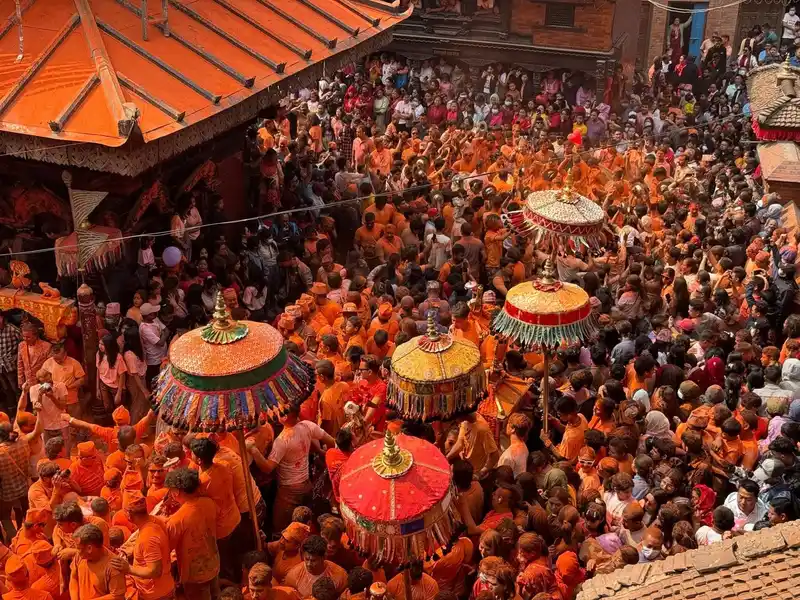
Balkumari gives Thimi Bisket Jatra its main sacred center.
Local tradition tells a story of a merchant from Thimi and a princess of Lubhu. The princess agreed to come with him only if she could bring Goddess Balkumari with her. In this telling, Balkumari came from Lubhu to Thimi, and the goddess became the protecting deity of the settlement.
This story makes Balkumari more than a temple name. She arrives with migration, marriage, protection, and the founding memory of Thimi’s sacred life.
Because of that story, the jatra becomes both public and personal.
Balkumari is remembered as a goddess who came into the life of Thimi, not as a deity worshipped from afar.
During Bisket Jatra, Balkumari’s presence joins the old town through khats, music, sindoor, and visits between deity spaces. Thimi remembers its goddess by carrying her influence through the city.
Balkumari Temple And Layaku
Balkumari Temple is the heart of Thimi’s Biska season.
The goddess’s main image has an old relationship with Layaku, the historic Thimi palace area. Local accounts say the main idol comes out during Bisket Jatra, making the festival a rare community moment for Balkumari’s presence.
People gather around the temple, offer worship, carry deity khats, and move through the old lanes.
The temple area becomes the center from which Thimi’s New Year devotion spreads outward.
From there, the festival no longer belongs only to one courtyard. It moves into lanes, palace memory, neighborhood shrines, and the routes where people wait for darshan.
Sindoor Jatra
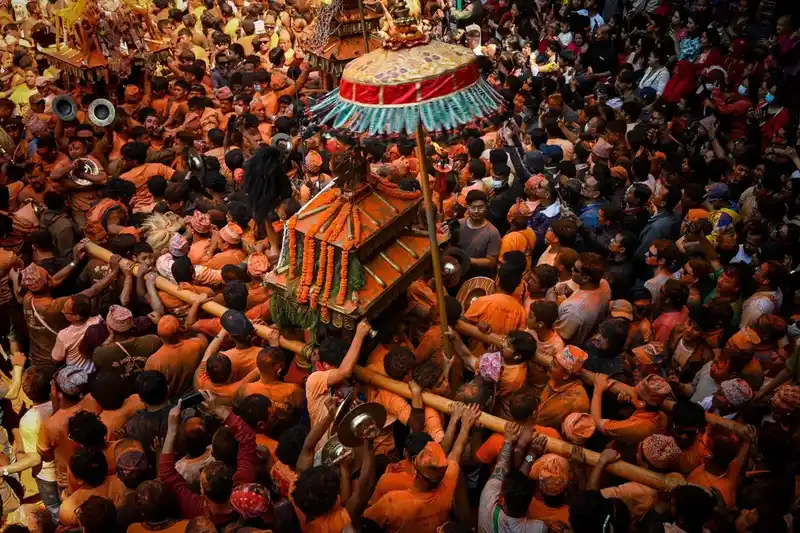
Sindoor Jatra is the most visible part of Thimi Bisket Jatra.
People throw orange vermillion powder into the air and smear it on one another while deity khats move through the streets. The whole route can turn orange, with music, shouting, greetings, and dense crowds around the chariots.
Local accounts often describe the broader Thimi Sindoor Jatra with 32 khats carrying different gods and goddesses. The number gives a sense of scale: this is not one procession with one deity, but a townwide gathering of many divine presences.
That 32-khat memory also shows why Thimi stands apart from Bhaktapur’s biska.
Bhaktapur pulls the great Bhairavnath chariot with the force of the old royal city. Thimi gathers many deity presences into a collective New Year procession.
Its power comes from convergence: Balkumari, Siddhikali Gan, local Ganesh forms, neighborhood khats, music groups, and the old lanes filling with sindoor. The color makes the gathering visible, but the deities give the color its sacred direction.
Siddhikali Gan
Siddhikali also has a strong place in Thimi’s Biska season.
In one local phase, Siddhikali Gan gathers at Siddhikali Temple with several deity khats, including forms of Ganesh and other associated deities. The procession carries music, vermillion, fire, and old neighborhood participation.
On the following morning, Siddhikali Gan joins the larger Balkumari-side gathering for Suthasiya Biska Jatra, also called Balkumari Jatra in some local descriptions.
As Siddhikali Gan moves toward the Balkumari side, Thimi’s jatra gathers itself.
A local deity group leaves its own temple area, enters the wider New Year procession, and becomes part of the town’s shared worship.
Suthasiya Biska Jatra
Suthasiya Biska Jatra brings the Balkumari side of the festival into fuller movement.
Deity khats gather around Balkumari Temple, and the procession moves through Thimi with music, sindoor, and worship. Some local descriptions speak of 19 khats in this phase, while the wider Sindoor Jatra is often remembered through 32 chariots.
The count changes by phase, but the rhythm stays clear: Thimi’s Biska happens through many deities meeting, moving, and receiving worship across different parts of the old town.
Here, Thimi becomes the wider Madhyapur gathering. First the local deity groups move from their own sacred points. Then they gather around Balkumari’s side. Then the surrounding settlements appear in the same Biska season with their own sacred duties.
Bode, Nagadesh, and Tigani do not become copies of Thimi. They join the same season from their own deity centers, bringing their local vows and deities into the shared Biska current.
Prachanda Bhairab Route
Prachanda Bhairab gives Thimi’s Biska route another sacred anchor.
Local tradition gives Balkumari’s chariot a more focused route than many other processions. Her route runs toward Prachanda Bhairab, marking an older sacred span of the settlement.
That route gives Thimi’s jatra a different shape from Bhaktapur. It shows Thimi as a sacred town held between its guardian goddess, Bhairab presence, and neighborhood deities.
Balkumari Temple is the main sacred center for Thimi Bisket Jatra.
Layaku Thimi carries the old palace memory and the connection with Balkumari’s image.
Siddhikali Temple draws worshippers during the Siddhikali Gan procession and the Biska events around it.
Prachanda Bhairab Temple marks another key end of the old sacred route.
The movement between Balkumari and Prachanda Bhairab gives Thimi’s jatra its local shape.
The old lanes of Madhyapur Thimi matter as much as the temple courtyards. During Sindoor Jatra, the street itself becomes the place where deity, music, color, and community meet.
The wider Madhyapur relationship also belongs here.
Bode, Nagadesh, and Tigani sit close enough to share the Biska season, but each carries a different sacred focus.
Thimi is the best place to see the collective Sindoor Jatra energy; the other settlements show how local vows and deities feed that energy from the edges.
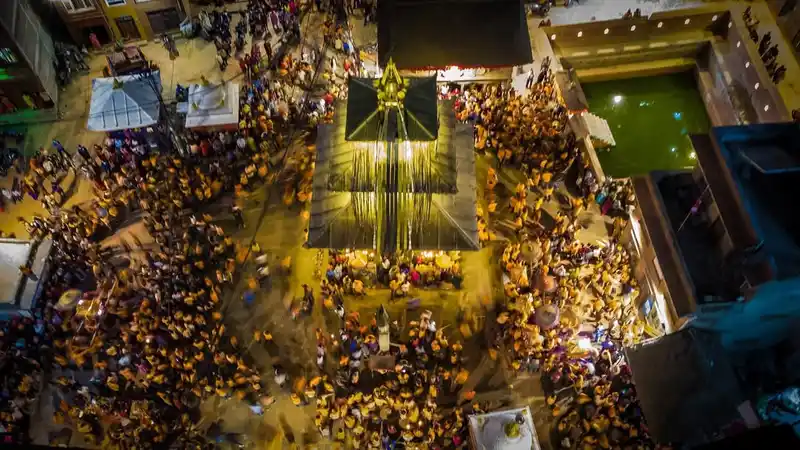
Visitors usually see orange before they understand anything else.
Sindoor rises from the crowd, covers faces and clothes, and settles on temple stones, khat poles, drums, and the old lanes.
Deity khats move through the streets. Dhimay music leads the procession. People greet one another, shout, laugh, pray, and make way for the khats.
The crowd can become dense.
The color can stain clothes, cameras, phones, and bags. The festival is joyful, but the khats and crowd movement still deserve respect.
After the first shock of color, the pattern becomes clearer. The khats are not simply passing through a festival crowd. They are the reason the crowd moves, pauses, opens, and gathers again.
Compared with Bhaktapur, Thimi’s Biska is more color-forward and townwide.
Compared with Bode, it is less vow-centered and more collective.
Compared with Nagadesh and Tigani, it is broader and more public.
Thimi’s strength is the gathering of many deities and neighborhoods under sindoor and music.
It lets visitors see Biska as a collective Madhyapur celebration, while nearby settlements carry the vow, Siddhi Ganesh, and Nil Barahi traditions in their own ways.
Start with the orange streets, then follow the deities.
Sindoor catches the eye, but Balkumari and the khats carry the story.
The current Nepali calendar and local notices carry the date for that year.
Baisakh 2 is usually the main day visitors associate with Thimi Sindoor Jatra, but local processions can begin earlier or continue around nearby days.
Wear clothes that can take sindoor stains. Protect phones, cameras, bags, and eyewear.
Arrive early and choose a place where you can step aside when khats pass. Avoid blocking deity carriers, musicians, elders, or ritual teams.
Ask before taking close photos of people worshipping, carrying khats, or receiving sindoor.
The color may look playful, but the jatra belongs to local deity worship and New Year devotion.
What is Bisket Jatra in Thimi?
Bisket Jatra in Thimi is Madhyapur Thimi’s Newar New Year jatra centered on Balkumari, Sindoor Jatra, deity khats, orange vermillion, dhimay music, Siddhikali Gan, and local processions.
Is Thimi Bisket Jatra the same as Bhaktapur Biska Jatra?
No. They share the Biska season, but Bhaktapur centers on Bhairavnath’s large chariot, Bhadrakali, and Lyo Sin Dyo. Thimi centers on Balkumari, Sindoor Jatra, khats, music, and orange vermillion.
When is Sindoor Jatra in Thimi?
Sindoor Jatra in Thimi usually falls around Baisakh 2, just after Nepali New Year. Local notices give the date and procession timing each year.
Why do people throw sindoor?
Sindoor marks auspiciousness, blessing, greeting, and New Year joy. During Thimi’s jatra, people throw and smear orange vermillion as deity khats move through the town.
Are there really 32 chariots in Thimi Sindoor Jatra?
Many local descriptions speak of 32 deity chariots or khats in the broader Sindoor Jatra. Specific phases may gather different groups of khats, such as Siddhikali Gan or Balkumari-side processions.
How is Thimi connected with Bode, Nagadesh, and Tigani?
Thimi works as the wider Madhyapur gathering point for the Biska season. Bode brings the tongue-piercing vow, Nagadesh joins through Siddhi Ganesh devotion, and Tigani brings Nil Barahi. Together, they form the shared Sindoor Jatra world around Madhyapur.
Where can visitors go for Thimi Bisket Jatra?
Balkumari Temple, Layaku Thimi, Siddhikali Temple, and the old town route are the main places to understand the festival.