
- Event Name
- Saraswati Puja - Basant Panchami
- Duration
- 1 day
- Location
- Kathmandu Valley, Observed across Nepal in schools, colleges, homes, Saraswati temples, and wisdom-related Buddhist-Hindu spaces such as Swayambhu Hill.
- Category
- Major Festival
- Tradition
- Saraswati Puja, Basant Panchami, Vasant Panchami, Shree Panchami, Magh Shukla Panchami, Akshar Abhyas, first writing, books and pen worship, school puja, music and art worship, yellow flowers, spring season



Saraswati Puja in Nepal celebrates the goddess of learning, speech, music, art, and wisdom. The day is also called Basant Panchami, Vasant Panchami, or Shree Panchami.
The festival falls on Magh Shukla Panchami, usually in January or February.
For students, this is among the most familiar festival days of the school year.
Books, pens, notebooks, musical instruments, art materials, and school spaces are placed before Saraswati with the hope that learning begins with clarity and respect.
For younger children, the day is often connected with first writing.
Parents may take a child to a temple, school, or family puja space and help them write their first letters. That small act makes Saraswati Puja feel very close to family life: a child, a slate or notebook, a pen or chalk, and the first step into learning.
Saraswati Puja is a festival of learning.
Saraswati is worshipped as the goddess of knowledge, language, poetry, music, art, memory, speech, and refined understanding. Her veena, book, rosary, and white lotus all point toward learning that is disciplined, creative, and clear.
In Nepal, the festival belongs naturally to students, teachers, writers, musicians, artists, and families with school-age children.
It is devotional, but it is also practical.
Children want good marks. Parents want their children to study well. Teachers gather students for puja. Musicians and artists honor the tools of their work. Even people who are not very ritual-focused may still feel that books and learning deserve respect on this day.
Saraswati Puja falls on Magh Shukla Panchami, the fifth day of the bright lunar fortnight of Magh.
In the English calendar, it usually falls in January or February. The exact date changes each year.
The day also marks the coming of spring.
Basant means spring, so the festival carries a softer seasonal feeling: yellow flowers, cleaner skies after winter, school courtyards, and the sense that a new learning season is opening.
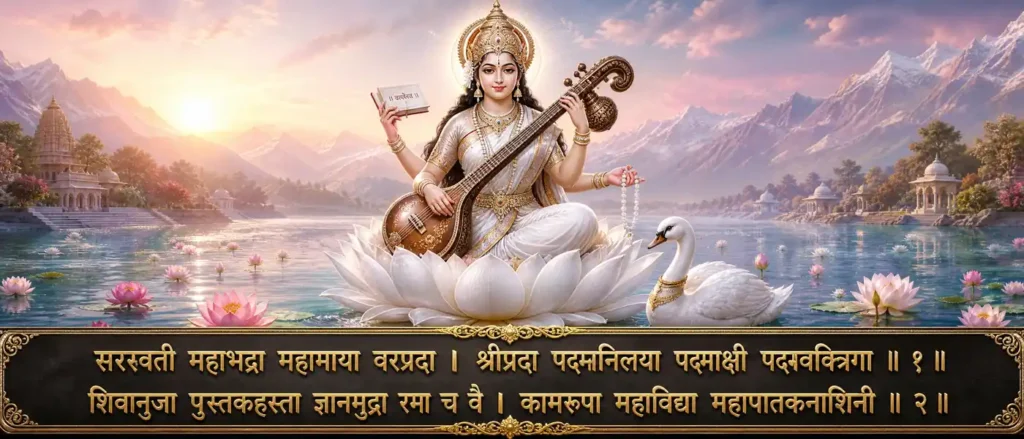
Saraswati begins as a Vedic river and goddess, and over time becomes the goddess of speech, knowledge, music, and learning.
In later Hindu worship, she is part of the wider Devi world and is often connected with Brahma, creation, language, and the ability to understand.
She is not worshipped for wealth or power. Her gift is clarity.
That is why students place books and pens before her.
The prayer is simple in feeling: let learning become easier, let speech become cleaner, let the mind become sharper, and let art or music flow with grace.
In Nepal, Saraswati also has a Buddhist layer.
Nepalese Buddhist traditions worship Saraswati as a wisdom deity, and her worship is often connected with Manjushri, the bodhisattva of wisdom.
Swayambhu Hill is especially celebrated because Manjushri and Saraswati worship overlap in the Kathmandu Valley imagination of knowledge, speech, and learning.
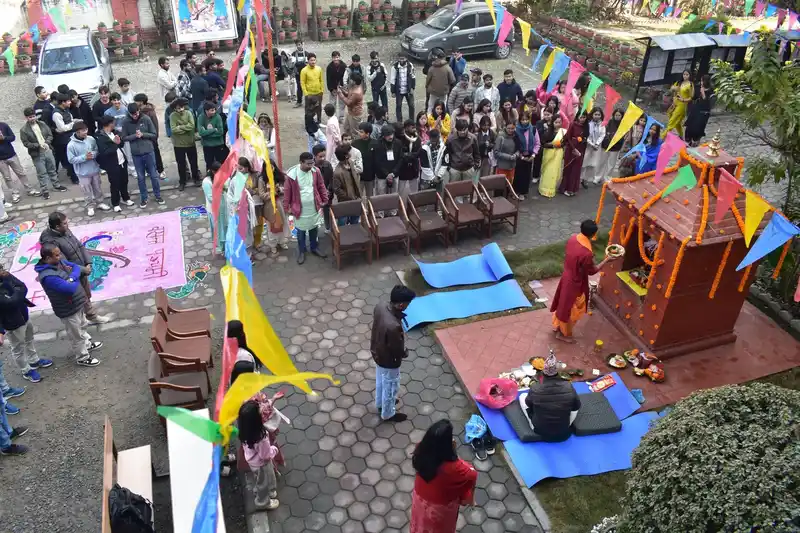
Saraswati Puja is observed across Nepal in schools, colleges, homes, temples, music institutes, art spaces, and local learning shrines.
Schools, gurukuls, and colleges are often the most visible places.
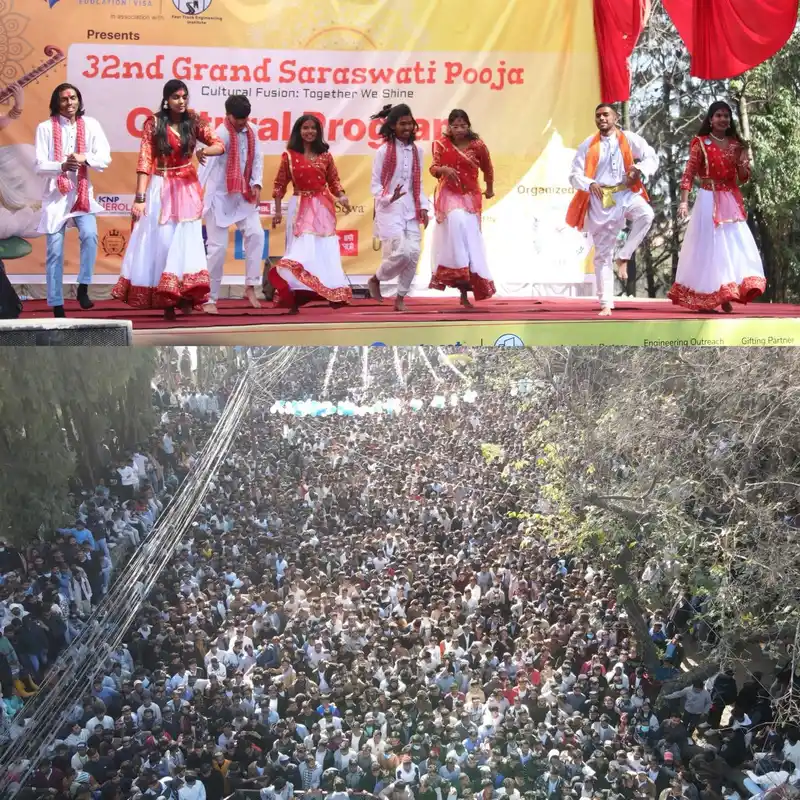
Students gather in uniforms or festive clothes, teachers arrange the puja, books and stationery are placed near Saraswati’s image, and the day may include prayers, songs, speeches, and small cultural programs.
In Kathmandu Valley, many families visit Saraswati temples or wisdom-linked spaces. Swayambhu Hill has a strong cultural and devotional feeling because of the Manjushri-Saraswati connection in Nepalese Buddhist and Hindu practice.
Local Saraswati shrines also carry the day.
Some are standalone temples. Others are smaller shrines inside larger temple complexes.
In Pokhara, for example, the Bindhyabasini temple complex includes a Saraswati Mandir along with other shrines and learning spaces.
For many families, the nearest school, neighborhood temple, or child’s classroom is the real Saraswati Puja place.
School Puja
Saraswati Puja is a festival where schools become devotional spaces.
Students bring flowers, notebooks, pens, and sometimes musical instruments.
Teachers help arrange the puja. A picture or murti of Saraswati is placed on a decorated table or altar, and the school courtyard may fill with marigolds, incense, tika, and morning prayers.
Many private preschools also use the day to open or promote admission for nursery, kindergarten, and early classes. This can look surprising to visitors because Saraswati Puja does not mark the formal start of the academic year.
The reason is devotional.
Saraswati is the goddess of learning, speech, memory, music, and clear understanding, so beginning a child’s education under her name feels auspicious to many families. Admission on this day carries the feeling that the child is stepping into learning with Saraswati’s blessing.
So around Saraswati Puja, travellers may notice school gates, banners, flyers, and social media posts saying admission open, especially for preschool and junior classes.
First Writing For Children
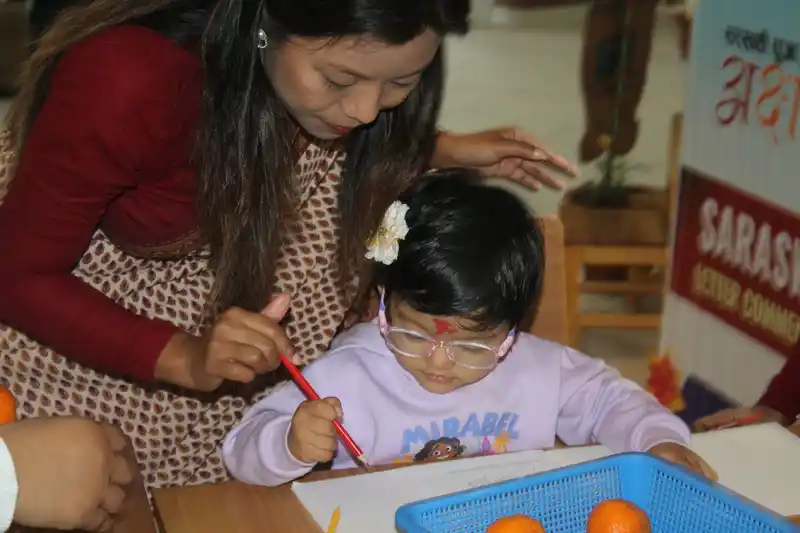
Many families choose this day for a child’s first letters.
Parents may guide the child’s hand over a notebook, slate, rice plate, or chalkboard. The letters may be simple: the alphabet, Om, Shree, or the child’s first written marks.
The point is not a large ritual. The emotion is that learning has begun.
Books, Pens And Instruments
Books and pens are treated with special respect on Saraswati Puja.
Some students keep their books near the puja space before reading from them again.
Musicians place a harmonium, madal, flute, guitar, or other instrument near Saraswati’s image.
Artists may include sketchbooks, brushes, or tools of their craft.
Yellow Flowers And Spring
Basant Panchami carries the color of spring.
Yellow flowers, marigolds, spring blossoms, and bright clothing are common in many places, though in Nepal practice varies by family and school. The color gives the day a cheerful feeling, quieter than Holi or Tihar.
Saraswati And Manjushri
In Kathmandu Valley, Saraswati Puja also touches the Manjushri story.
Manjushri is remembered as the wisdom bodhisattva who cut open the valley and made Kathmandu habitable. At Swayambhu and nearby wisdom-linked places, Saraswati and Manjushri sit naturally in the same world of learning, speech, and insight.
Swayambhunath is the strongest Kathmandu Valley link for Saraswati Puja because of its Manjushri and wisdom associations. The hill is Buddhist, Hindu, local, and educational all at once, which makes it natural for students and families.
Saraswati temples across Nepal carry the day more directly. Some maybe small neighborhood shrines, but ,on Saraswati Puja, they can become full of students, flowers, books, and parents bringing children for first writing.
Bindhyabasini in Pokhara is mainly a Bhagwati temple complex, but it includes a Saraswati Mandir and a Sanskrit learning environment. It can be part of a wider Pokhara learning and devotion route.
Schools, gurukuls, and colleges also function like event spaces on this day.
For Saraswati Puja, a school courtyard can feel as central as a temple for the students who study there every day.
At schools, visitors usually see decorated Saraswati images, flower garlands, tika, incense, books, pens, notebooks, and students gathered around the puja area.
At temples, families may arrive with children, flowers, sweets, fruits, stationery, or small offerings.
Some children write their first letters. Students may touch books to the goddess’s feet or keep them near the puja place.
At busier places, expect queues, school groups, parents taking photos, and small vendors selling flowers, prasad, notebooks, pens, and puja items.
The day has a gentle mood. It feels younger than many festivals because children and students are everywhere.
Use the current Nepali calendar for the exact date because Saraswati Puja changes every year.
If you are visiting a popular temple with children, go early. The morning can be busy with school groups and families.
For first writing, choose a place that feels manageable for the child. A calm school puja or neighborhood shrine may be easier than a crowded temple.
If you are going to Swayambhu, plan for stairs, traffic, parking, and crowds around the main hill. Families with small children may want extra time.
If you are checking school programs, confirm whether visitors are allowed. Some school pujas are for students and parents only.
If you see admission open banners around schools, that is also part of the season. It does not always mean the academic year has started; many schools use Saraswati Puja as an auspicious day to begin inquiry or enrollment for young children.
What is Saraswati Puja in Nepal?
Saraswati Puja is the festival of Saraswati, the goddess of learning, speech, music, art, and wisdom. In Nepal, it is strongly connected with students, schools, books, pens, and first writing for children.
When is Saraswati Puja?
Saraswati Puja falls on Magh Shukla Panchami, usually in January or February. The exact English date changes each year.
Is Saraswati Puja the same as Basant Panchami?
Yes. In Nepal, Saraswati Puja, Basant Panchami, Vasant Panchami, and Shree Panchami all refer to the same festival day, though people may use different names depending on family, school, or region.
Why do students worship books and pens on Saraswati Puja?
Books, pens, notebooks, and instruments represent learning. Students place them near Saraswati to show respect for knowledge and to begin study with a clear mind.
What is first writing on Saraswati Puja?
First writing is when a young child is guided to write letters for the first time. Families may do it at home, school, or temple on Saraswati Puja because the day is considered especially connected with learning.
Why do schools open admissions on Saraswati Puja?
Some schools, especially preschools, open or promote admission around Saraswati Puja because Saraswati is the goddess of learning and speech. Families see the day as a good time for a child to begin education under her blessing, even though the formal academic year may begin later.
Where can I go for Saraswati Puja in Kathmandu?
Swayambhu Hill is a strong choice because of its Manjushri and wisdom associations. Local Saraswati temples, schools, and neighborhood shrines are also common places for the day.
Is Saraswati Puja only a Hindu festival?
Saraswati Puja is mainly a Hindu festival, but in Nepal Saraswati also appears in Nepalese Buddhist practice, especially through wisdom and Manjushri-related traditions.