
- Event Name
- Gai Jatra - Sa: Paru
- Duration
- 1 day
- Location
- Bhaktapur, Kathmandu Valley, Kirtipur, Patan, Kathmandu, Bhaktapur, Patan, Kirtipur, Panga, Naga, and Newar settlements across Nepal
- Category
- Kathmandu Valley Jatra
- Tradition
- Sa Paru, cow procession, ancestor remembrance, Pratap Malla story, Taha-Macha, Ghintang Ghisi, satire, public comedy, family offerings



Gai Jatra, also called Sa Paru in Nepal Bhasa, is a Newar festival of remembrance for family members who died during the past year. It is strongest in Kathmandu Valley, but Newar communities across Nepal also observe it in their own towns, neighborhoods, and community spaces.
The festival usually falls in Bhadra, on the day after Janai Purnima / Gunhu Punhi. The English date changes every year.
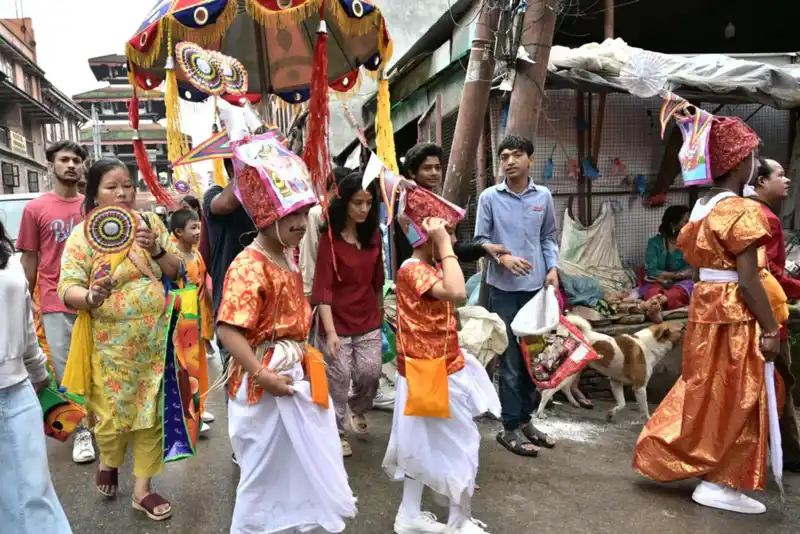
Gai Jatra is often easy to recognize from the outside: children dressed as cows, bamboo memorial frames, music, masks, comedy, satire, and crowds moving through old streets.
But the festival begins with grief. A family has lost someone. The household brings that loss into the street so the departed is remembered publicly, and so the living family sees that it is not alone.
That is the heart of Gai Jatra. The cow, the child in cow dress, the procession, the laughter, and the satire all come after death has already entered the house.
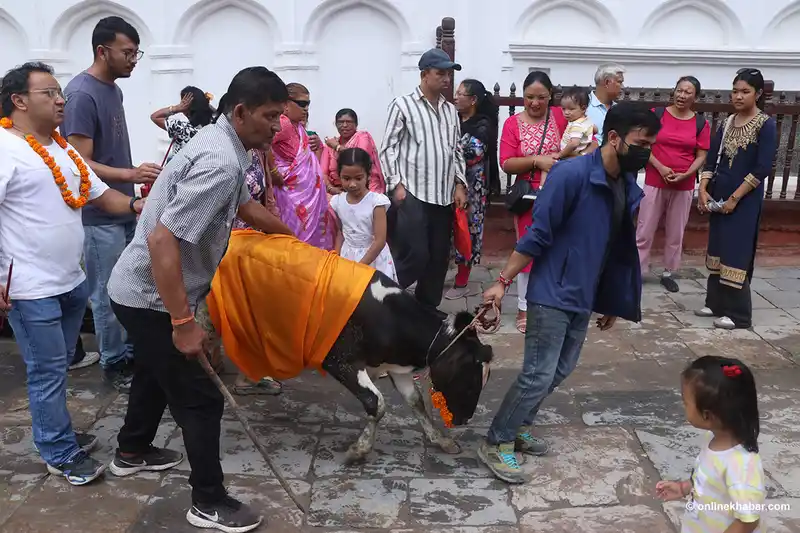
Gai Jatra joins two experiences that usually feel far apart: mourning and laughter.
The sacred side begins with the cow.
In Hindu and Newar belief, the cow is a holy guide for the journey after death. When a family has lost someone in the past year, the cow procession helps the departed continue toward the next world. If a real cow is not available, a child may dress as a cow and walk for the dead.
That child is not only wearing a costume. The child stands in for the cow that guides the departed soul.
In some processions, children wear cow-like headdresses, drawn moustaches, long cloth, or special dress. The clothing, the route, and the public walk all carry the same duty: the beloved dead should not be sent onward silently.
The public side carries the living family.
On Gai Jatra, many bereaved families come out on the same day. A household that may have been grieving inside its own walls suddenly sees other households walking with the same wound. The street becomes a place where grief is shared.
Then laughter enters the day, not as a denial of death but as a way of living after it.
Satire, jokes, caricature, cross-dressing, songs, and public performances grew around Gai Jatra because the festival also teaches the living to return to the world.
The best-known story of Gai Jatra comes from King Pratap Malla of Kantipur.
The king lost his son, often remembered as Chakravartendra Malla. The queen fell into deep grief and could not be consoled.
The palace had lost a child, but the king knew that death had also touched many ordinary homes in the city.
To show the queen that her sorrow was not hers alone, Pratap Malla asked families who had lost someone during the year to come out in procession.
When the queen saw so many households carrying their grief through the streets, she understood that death had visited many families, not only the royal palace.
But the king wanted more than recognition of shared loss.
He wanted the queen to smile again, even if only for a moment. So people began to perform, mock, joke, and speak boldly. They ridiculed powerful people, laughed at social habits, and made public the things people usually whispered.
The queen smiled, and the festival kept that form.
Because of that story, Gai Jatra can carry a cow procession in the morning and satire later in the day.
The mourning comes first. The laughter follows because grief needs a way back into life.
Gai Jatra falls in Bhadra, usually around August or September in the English calendar.
In the Nepal Era calendar, the festival is observed on the day after Janai Purnima / Gunhu Punhi. The Nepal Bhasa name Sa Paru carries the date inside it: Sa means cow, and Paru refers to Pratipada, the first lunar day.
The exact English date changes every year, so visitors should check the current calendar before planning around the processions.
Gai Jatra comes just after Janai Purnima / Gunhu Punhi.
In Newar communities, this timing places the festival inside a wider season of family ritual, remembrance, monsoon days, and neighborhood gatherings.
The cow gives Gai Jatra its sacred path.
In Hindu mythology, the cow helps the departed soul travel beyond this world. During the travel, the soul reaches the difficult Vaitarni (Baitarani), river on the way toward Yamaraj’s realm. At that moment, a sacred cow gives the soul a tail to hold, so the crossing becomes possible.
That belief explains why families who lost a relative during the year join the jatra.
The procession is not only a public memorial. It is a ritual act of care for someone who can no longer walk with the family in ordinary life.
This is why a child dressed as a cow carry so much meaning. The child walks where the departed cannot.
The family follows because grief needs action: a route, a body, a sound, a public sign.
Yamaraj, the god of death, is also remembered on this meaning.
Gai Jatra does not treat death as an abstract idea. It gives death a road, a guide, and a day when the city can face it directly.
Along the jatra route, people may offer fruits, sweets, grains, oats, water, or small food packets to those in the procession. These offerings are not random generosity. They support the family and the ritual journey through the city.
Because only families who lost someone in the past year traditionally join this procession, the day also becomes a visible record of the shared public grief and consolation.
Kathmandu’s Gai Jatra carries the strongest memory of Pratap Malla because the story belongs to Kantipur and the Hanuman Dhoka palace.
Families who lost someone during the year come into the streets with cow processions, children in cow dress, family members, musicians, and offerings. Some boys may appear as Jogis or holy ascetics, with a painted third eye of Shiva on the forehead.
The route through inner Kathmandu turns private mourning into a public procession.
Processions move through the old city core, including areas such as Asan, Indra Chowk, and Kathmandu Durbar Square.
Hanuman Dhoka and the old palace area are important because the king-and-queen story lives there. The queen’s grief, the city’s processions, and the beginning of public satire all point back to that royal center.
Kathmandu also became one of the strongest places for the comedy and satire side of Gai Jatra.
Public jokes, political mockery, stage shows, caricature, and social criticism all belong to the wider Gai Jatra season. A day that began by acknowledging death also became a day when people could speak uncomfortable truths with humor.
That freedom is not separate from grief. The story of the queen gives it a reason.
Once the city admits that everyone suffers, laughter becomes a way to loosen fear and pride.
In the older political timeline, Gai Jatra also gave ordinary people a rare public space to mock rulers, officials, elites, and social habits without the usual fear.
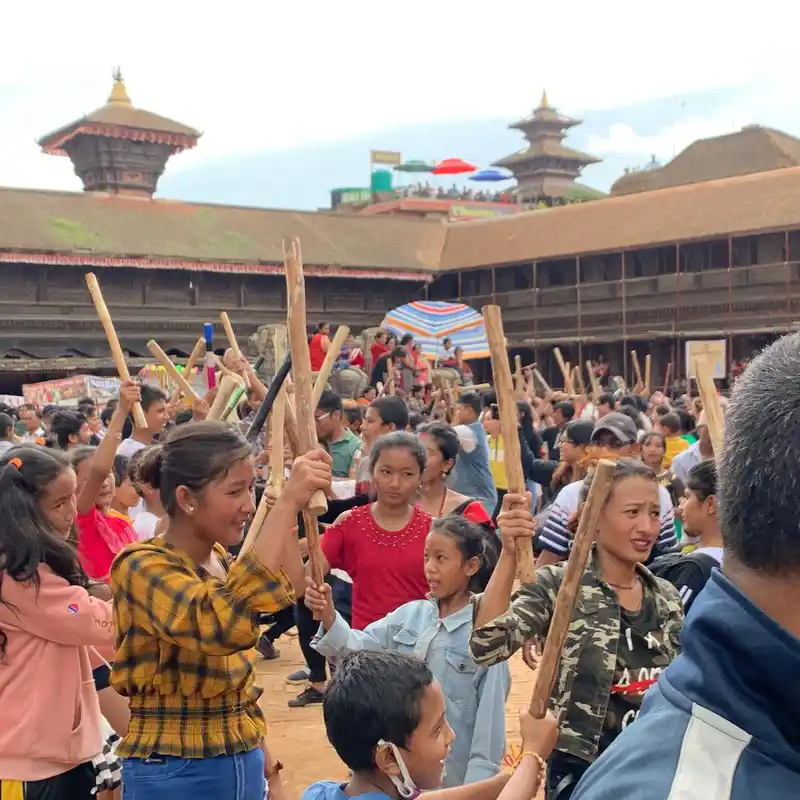
Bhaktapur gives Gai Jatra one of its most visible local forms.
Here, families often make Taha-Macha, a bamboo frame wrapped in cloth and carried through the city for the deceased.
Some forms rise in tiers, are wrapped in bright or printed fabric, and may be topped with a straw form recalling the cow. A photo, belongings, or clothing of the departed may be placed on the structure. The Taha-Macha turns a family loss into a visible memorial that moves through the streets.
Different toles bring out their Taha-Macha, so Bhaktapur’s Gai Jatra can become a long chain of neighborhood remembrance.
Bamboo, cloth, a photograph, family members, musicians, and the old street route all move together. The departed person is not hidden from the city. The city sees and receives the memory.
Bhaktapur also has larger ritual forms around the procession.
The Taha-Macha from Lakolachhen is known in the community for being guided by a large straw-covered Bhailya Dya, a Bhairab form. Ajima / Bhadrakali also appears in the local stories. These figures give the procession a protective and deity-centered presence, not only a family memorial form.
After the procession, Bhaktapur’s Ghintang Ghisi dance gives the jatra its continuing public sound.
Dancers move in rows, often striking sticks together, and the rhythm keeps the day from becoming only a funeral march.
It gives the streets a pulse after the memorial forms pass.
The dance can continue for days, from Gai Jatra toward Krishna Janmashtami. Men wear women’s dress, people use masks and face paint, and children appear as gods, goddesses, or other figures.
In Bhaktapur, Gai Jatra does not end as soon as one procession passes. The city keeps moving through dance, music, tole participation, humor, and family remembrance.
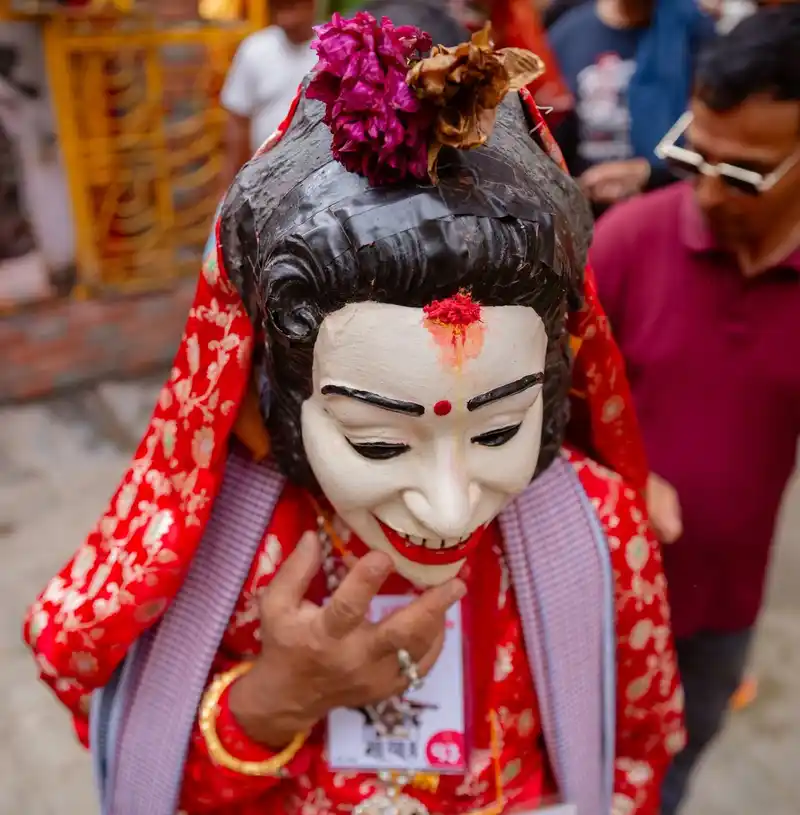
Kirtipur has its own Gai Jatra life, especially in the old settlements of Kipu, Naga, and Panga.
Local belief says the gates of heaven open on this day.
The Gai Jatra helps the beloved dead reach those gates. It shows a direct devotional force of Kirtipur’s jatra: the family walks because the departed needs a path.
Also, Kirtipur does not always center the cow form in the same way Kathmandu does.
People may dress in forms of gods and goddesses. Men may dress as women and move house to house, calling families to come out and join the shared observance. The festival includes imitation, performance, and neighborhood rounds.
The festival also carries agricultural feeling.
Around this time, farming work has begun to ease, and families gather again after hard field labor. Feasting, visiting, performance, and neighborhood invitation therefore sit naturally with the ancestor side of the festival.
In Kirtipur, Gai Jatra is not only a grief procession.
It also renews social ties inside the old town. Households call each other out. Dancers move through lanes. Families remember the dead and return to community life together.
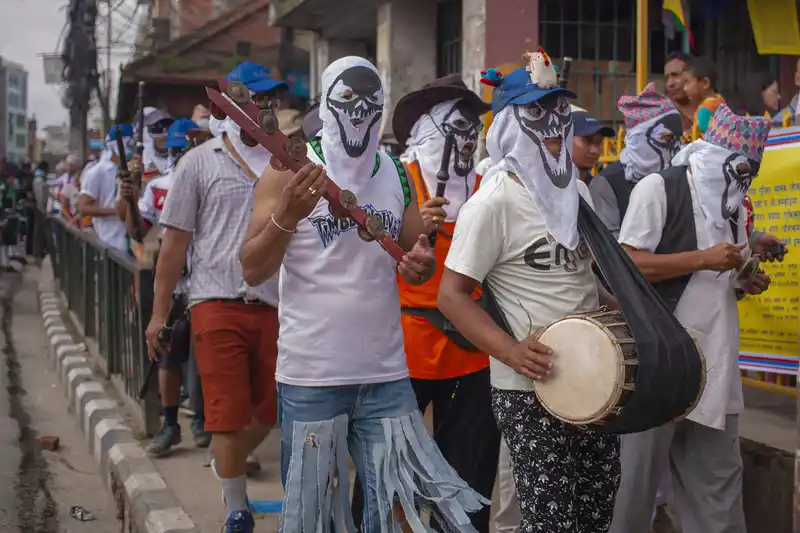
Patan also observes Gai Jatra as part of the Newar festival calendar.
The form can be quieter than Kathmandu or Bhaktapur in some places.
Lalitpur has another powerful devotional procession around Gai Jatra: Mataya, also called Matiyaa.
In Mataya, devotees walk a long route through Patan, visiting many chaityas, stupas, and shrines while offering lamps. It has its own Buddhist devotional meaning and strong local participation, so it should not be confused with Gai Jatra.
Lalitpur’s season of remembrance and procession is wider than one day.
Gai Jatra belongs to the family-and-cow remembrance line, while Mataya carries its own devotional path through Patan.
Gai Jatra is not limited to one square in Kathmandu.
It is a Newar festival, and Newar communities live across Nepal.
The Kathmandu Valley remains the strongest public center, especially Kathmandu, Bhaktapur, Patan, Kirtipur, and Madhyapur-area settlements. But Newar families in towns outside the Valley also observe Sa Paru through community processions, family remembrance, cultural programs, or smaller local gatherings.
This wider spread also makes sense historically.
Newars moved from the Valley into trade towns and settlements across Nepal, including places such as Nuwakot, Banepa, Dhulikhel, Panauti, Dolakha, Chitlang, Bhimphedi, Pokhara, Tansen, and many other market towns. Where Newar families settled, they carried language, food, guthi habits, worship, and festivals with them.
Although, the jatra form may change from place to place, the heart stays the same: the dead are remembered, the living gather, and grief enters public life with ritual and humor.
Gai Jatra is famous for satire because the festival gives society one day to laugh at itself.
The Pratap Malla story gives the reason. The king could not remove the queen’s grief by command. He had to show her other grieving families and then let humor enter the palace. The laughter came after the city had already faced death.
Over time, that laughter became sharper.
Performers mocked powerful people.
Comedians exposed hypocrisy.
Political satire, social criticism, cross-dressing, caricature, and public comedy all found space inside the Gai Jatra season.
This is why Gai Jatra can feel unusual to visitors.
A festival about death also becomes a day of jokes. But inside the tradition, the two sides belong together. Death humbles everyone. Humor reminds the living not to become too proud, too rigid, or too afraid.
Gai Jatra is most visible in Kathmandu Valley.
Kathmandu carries the Pratap Malla and Hanuman Dhoka story. Bhaktapur carries Taha-Macha, Bhailya Dya, Ajima, and Ghintang Ghisi. Kirtipur carries the old towns of Kipu, Naga, and Panga, with its belief in heaven’s gates and its neighborhood performances. Patan observes Gai Jatra within a wider Lalitpur season that also includes Mataya.
Outside the Valley, Newar communities across Nepal keep the festival alive in smaller or locally adapted forms. The scale may change, but the meaning remains close to the same: families remember the dead, the cow or procession guides the departed, and the community helps the living carry grief.
Kathmandu Durbar Square / Hanuman Dhoka carries the Pratap Malla story and the old Kantipur palace world.
Bhaktapur’s old city gives Gai Jatra one of its strongest public forms through Taha-Macha processions and Ghintang Ghisi.
Kirtipur, including Kipu, Naga, and Panga, has its own belief, route, costumes, dances, and neighborhood feasting.
Patan / Lalitpur belongs to Kathmandu Valley’s Newar festival world, though Mataya is a separate devotional tradition.
Newar towns across Nepal carry Gai Jatra through community life.
Where Newar families have carried Sa Paru, the festival may appear in forms that are smaller than Kathmandu Valley but still central to the families who observe it.
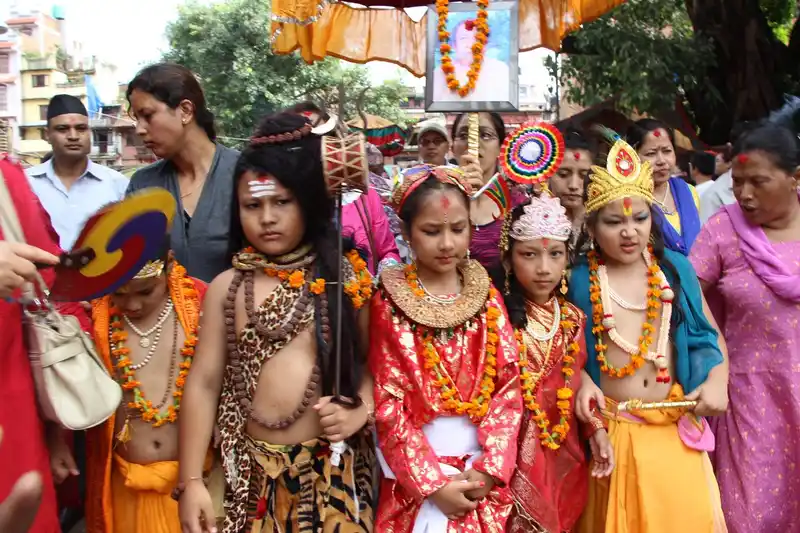
You may see children dressed as cows, families walking in memory of someone who died, musicians, masks, food offerings, framed photographs, and people standing along the lanes to give fruit, sweets, grains, or small packets.
In Kathmandu, you may see cow processions and public satire shaped by the Hanuman Dhoka story.
In Bhaktapur, you may see Taha-Macha bamboo memorial structures, tole processions, Ghintang Ghisi dance, masks, face paint, and large crowds moving through old streets.
In Kirtipur, you may see processions through the old towns, people dressed as gods or goddesses, imitation performances, house-to-house invitations, and community feasting.
In modern urban programs, you may also see comedy shows, political satire, media specials, and cultural performances around the Gai Jatra season.
Check the verified annual date before planning.
Gai Jatra follows the lunar calendar, so the English date changes every year.
Kathmandu is a good place if you want to understand the Pratap Malla story and the satire side of the festival.
Bhaktapur is one of the strongest places to see local jatra form because of Taha-Macha and Ghintang Ghisi. Arrive early and expect dense lanes.
Kirtipur is useful if you want a less tourist-centered but deeply local Newar observance, especially around Kipu, Naga, and Panga.
Patan can be visited during the season, but do not confuse Gai Jatra with Mataya. Both belong to Newar sacred life, but they are different observances.
If you are watching a family procession, keep respectful distance.
Many participants are remembering someone who died in the past year. Photographs, costumes, and performances may look colorful, but the day carries real family grief.
What is Gai Jatra?
Gai Jatra is a Newar festival of remembrance for family members who died during the past year. Families join cow processions or local memorial processions so the departed are remembered and guided.
What is Sa Paru?
Sa Paru is the Nepal Bhasa name for Gai Jatra. Sa means cow, and Paru refers to Pratipada, the first lunar day.
When does Gai Jatra happen?
Gai Jatra falls in Bhadra, on the day after Janai Purnima / Gunhu Punhi. The English date changes every year.
Why are cows used in Gai Jatra?
The cow is believed to help guide the departed soul on the journey after death. If a real cow is not used, a child may dress as a cow and walk in the procession.
Why is there comedy during Gai Jatra?
The comedy comes from the Pratap Malla story. After the king lost his son, he brought grieving families before the queen so she could see that death had touched many homes. Satire and humor then entered the festival to help grief return toward life.
Is Gai Jatra celebrated only in Kathmandu?
No. It is strongest in Kathmandu Valley, but Newar communities across Nepal also observe Gai Jatra or Sa Paru in local ways.
Where is Gai Jatra best to see?
Kathmandu, Bhaktapur, and Kirtipur are strong choices. Bhaktapur is especially known for Taha-Macha and Ghintang Ghisi, while Kathmandu carries the Hanuman Dhoka and Pratap Malla story.
Is Gai Jatra a Hindu or Buddhist festival?
Gai Jatra belongs to Newar religious and cultural life, where Hindu and Buddhist families both participate in different ways. The cow and Yamaraj side is strongly Hindu, while Newar community practice gives the festival its local form.