
- Event Name
- Bisket Jatra In Tokha
- Duration
- 5 days
- Location
- Kathmandu Valley, Tokha, Old Tokha, especially wards 2 and 3 of Tokha Municipality. The main processions move through the historic Newar core, with ritual points such as Sapana Tirtha, Tapalakshi, Narayan Pokhari at Saraswati Chaur, Hasal Tole, Gachhe Tole, Dyo Chhens, and Vajrayogini in Shivapuri.
- Category
- Kathmandu Valley Jatra
- Tradition
- Tokha Bisket Jatra, Tokha Biska Jatra, Newar New Year, Sapana Tirtha bath, seven deity khats, Yosi/Lingo, Gahana Khojne, Narayan Pokhari, Taleju Guthi puja, Ganesh Kumari, Sindoor Jatra, Pyakhan dances, all-night bhajan, cloth-pull devotion, Vajrayogini bhoj, chaku tradition
Bisket Jatra In Tokha Day-by-Day Schedule for 2026 (2083 BS)
| Day | Date | Ritual / Event | Highlights & Notes |
|---|---|---|---|
Day 1 | Tuesday | April 14, 2026 Krishna Dwadashi | Vaishakha 1, 2083 BS | Sapana Tirtha, Seven Khats And Tapalakshi Vigil | After holy baths at Sapana Tirtha, seven deity khats enter the jatra and gather at Tapalakshi for the night with Newar bhajan and vigil. |
Day 2 | Wednesday | April 15, 2026 Krishna Trayodashi | Vaishakha 2, 2083 BS | Yosi, Gahana Khojne And Pyakhan | The Yosi or lingo rises as the khats encircle the area. The deities move to Narayan Pokhari for Gahana Khojne, with ritual bathing and Pyakhan dances. |
Day 3 | Thursday | April 16, 2026 Krishna Chaturdashi | Vaishakha 3, 2083 BS | Sindoor Jatra And Taleju Guthi Puja | The khats move through old Tokha with sindoor and music, gather at Hasal Tole, and receive Taleju Guthi puja with Ganesh Kumari. |
Day 4 | Friday | April 17, 2026 Krishna Amavasya | Vaishakha 4, 2083 BS | Final Tour, Cloth Pull And Return | The khats make their final village tour, families offer cloth across the route, the lingo comes down, and the deities return to their Dyo Chhens. |
Day 5 | Saturday | April 18, 2026 Shukla Pratipada | Vaishakha 5, 2083 BS | Vajrayogini Bhoj | Guthis, families, and management groups go to Vajrayogini Temple in the Shivapuri forest for final prayers and communal bhoj. |



Bisket Jatra In Tokha – Chaku, Sapana Tirtha, Music and Dance in Gallery
Tokha’s Biska identity comes from the seven deity khats, the Yosi raised with the khats around it, Gahana Khojne at Narayan Pokhari, the Pyakhan dances, the Taleju Guthi puja with Ganesh Kumari, and the cloth-pull devotion on the final day.
Bisket Jatra in Tokha is the Newar New Year jatra of old Tokha area of Kathmandu Valley.
The active jatra runs from Baisakh 1 to Baisakh 4, and the following day carries the post-jatra Vajrayogini bhoj.
Newar families mark the New Year through Sapana Tirtha bathing, seven deity khats, sindoor, Taleju Guthi puja, Ganesh Kumari, Pyakhan dances, night bhajan, cloth-pull devotion, and the raising and lowering of the Yosi or lingo.
Tokha sits in the northern part of Kathmandu Valley.
Today Tokha is a municipality, but the old settlement still carries its own identity through Nepal Bhasa, local temples, old lanes, chaku-making heritage, farming memory, and seasonal jatras.
Among the Biska celebrations of Kathmandu Valley, Tokha has its own form.
Bhaktapur has the great Bhairavnath chariot. Thimi has a famous Sindoor Jatra. Bode has the tongue-piercing vow. Nagadesh has Siddhi Ganesh. Tokha brings out its own local deities, receives Taleju puja, carries the chariots through the old town, and gathers the settlement around New Year worship.
Tokha Bisket Jatra marks the start of the new year through the local sacred life of the settlement.
Biska across the Valley carries the older Solar New Year meaning.
In Tokha, the meaning becomes local: families gather, deities move through the town, musicians play, and people begin Baisakh with worship, sindoor, bhajan, and community presence.
Tokha’s name is often explained through Nepal Bhasa words for sugarcane field. The town is famous for chaku, the dark sweet made from sugarcane juice.
During the New Year season, old farming memory and craft identity sit beside shrine worship and Newar town life.
The jatra therefore belongs to a place where field, food, shrine, family, dance, music, water ritual, and old Newar town life meet.
Tokha Bisket Jatra runs as a four-day active jatra from Baisakh 1 to Baisakh 4.
It arrives with the Nepali New Year season, close to other Biska forms in Bhaktapur, Thimi, Bode, Nagadesh, and nearby settlements.
The route, deity sequence, and daily timing can shift by year. Tokha ward updates, community pages, and residents usually give the clearest current procession details.
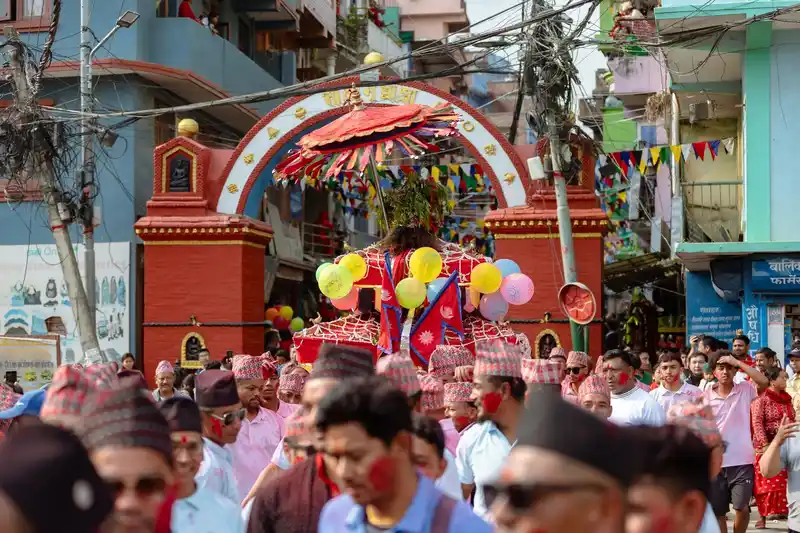
Tokha’s Bisket Jatra belongs to old Tokha, especially the historic settlement around Tokha Chandeshwari and Tokha Saraswati areas.
Chandeshwari Temple and Sapana Tirtha sit within Tokha’s wider sacred geography. For visitors, they show Tokha as more than a suburb north of Kathmandu. It is an old Newar settlement with its own shrines, water places, deity houses, and ritual memory.
The Biska season brings Tokha’s sacred geography into New Year worship. Tokha marks the new year through seven traditional deity khats: Ganesha, Kothu Ganesh, Sapan Binayak, Chandeshwori, Masankali, Mahadev, and Saraswati.
The jatra lives most strongly in Tokha’s historic Newar core, now mainly wards 2 and 3 of Tokha Municipality. During the festival days, this part of Tokha carries the chariots, music, bhajan, sindoor, and family movement.
The Taleju Guthi puja also gives Tokha Bisket Jatra an old Kathmandu Valley royal-religious relationship.
When the puja arrives with Tokha’s living Ganesh Kumari, Tokha’s local New Year worship meets the older Malla-era sacred order of the valley.
Baisakh 1: Sapana Tirtha, Seven Khats, And Tapalakshi Vigil
Tokha’s Bisket Jatra begins on Nepali New Year day after the holy baths at Sapana Tirtha.
The seven traditional deity khats then come into the jatra. Ganesha, Kothu Ganesh, Sapan Binayak, Chandeshwori, Masankali, Mahadev, and Saraswati each receive care from their respective guthis before the procession begins.
The khats move through the village and later gather at Tapalakshi for the night. Devotees stay awake in front of the resting khats, singing Newar bhajan through the night.
This first night carries its own devotion.
The khats rest together, the guthi groups remain close to their deities, and the night jaagram keeps the New Year worship alive until the next day.
Baisakh 2: Yosi, Gahana Khojne, And Pyakhan
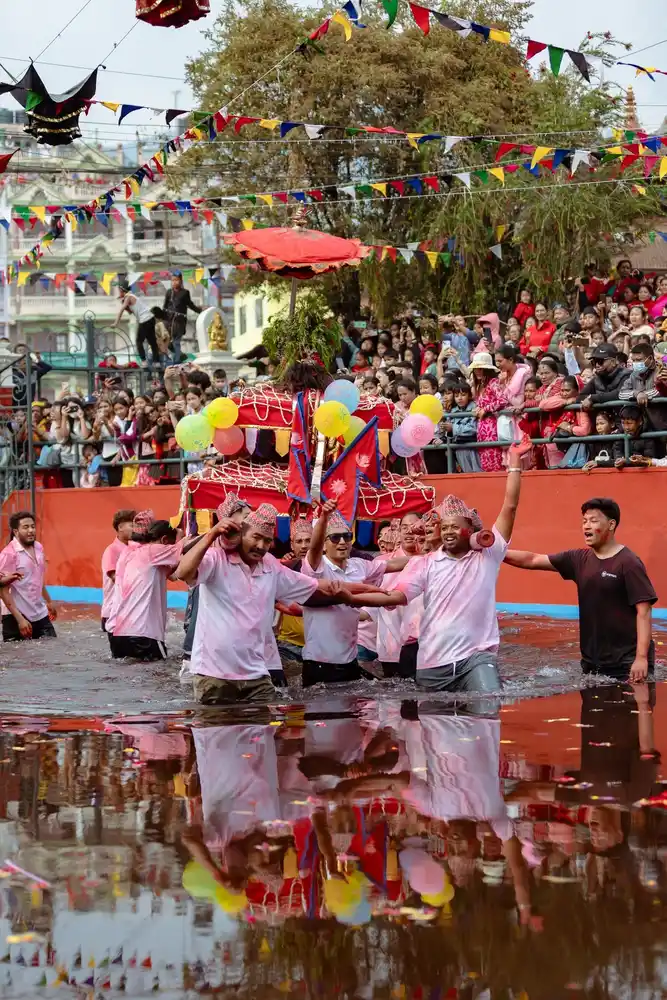
Baisakh 2 brings one of Tokha’s most distinctive jatra days.
The 54-hand-long Yosi, a ceremonial lingo, rises as the seven khats encircle the area. The pole carries serpent and dragon memory inside the New Year festival and gives the town a strong ritual center for the day.
The khats then move toward Narayan Pokhari at Saraswati Chaur for Gahana Khojne, the ritual of searching for ornaments. The deities receive a ceremonial bath in the pond, and locals remember it as a search for lost divine ornaments.
This is one of the clearest Tokha-specific rituals of the jatra. The seven khats, the pond, the bathing, and the search for divine ornaments make the day feel different from Bhaktapur’s chariot pull or Bode’s tongue-piercing vow.
Traditional Pyakhan dances move through the streets. Nag Pyakhan, Mak Pyakhan, and Mayur Pyakhan bring snake, monkey, and peacock forms into the festival, giving Tokha’s Bisket Jatra a performance tradition of its own.
Baisakh 3: Sindoor Jatra, Hasal Tole, And Taleju Guthi Puja
Baisakh 3 begins with Sindoor Jatra.
Devotees lift the deities from Tapalakshi and carry them through the inner alleys of old Tokha with vermilion powder, music, and darshan. The khats then gather at Hasal Tole.
Taleju Guthi puja arrives with Tokha’s living Ganesh Kumari. The gathered deities receive worship, and the arrival brings another powerful round of sindoor celebration through the town.
That Taleju moment gives the day its formal sacred turn.
The local khats have already moved through the settlement, and then the Taleju Guthi puja and Ganesh Kumari bring the older valley ritual order into the middle of Tokha’s own jatra.
Baisakh 4: Final Tour, Cloth Pull, And Return To Dyo Chhens
Baisakh 4 closes the active street processions.
The khats make their final village tour and reach Gachhe Tole. Families spread long white sheets of cloth across the streets, and devotees pull the chariots over them as an act of deep devotion.
The 54-hand-long lingo then comes down, and the deities return safely to their Dyo Chhens, the permanent deity houses. The street processions close with this return.
The cloth-pull devotion makes the final day feel personal. Families place cloth in the path of the khats so the deities pass over their offering before returning home.
Baisakh 5: Vajrayogini Bhoj
On Baisakh 5, the guthis, families, and management groups go up to Vajrayogini Temple in the Shivapuri forest.
They offer final prayers and share a large communal bhoj.
After four days of khat processions, sindoor, dance, bhajan, Taleju Guthi puja, and cloth devotion, the feast gives the jatra a family and guthi closing.
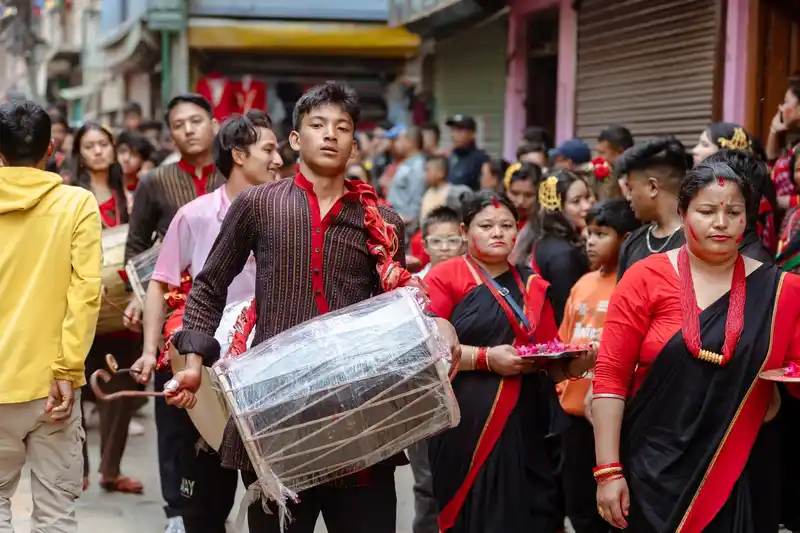
Tokha’s Bisket Jatra has its own complete local form.
Its identity comes from the seven deity khats, the Yosi raised with the khats around it, Gahana Khojne at Narayan Pokhari, the Pyakhan dances, the Taleju Guthi puja with Ganesh Kumari, and the cloth-pull devotion on the final day.
These practices give Tokha its own ritual order.
The jatra moves through the old settlement, returns to its deity houses, and closes with a guthi and family bhoj at Vajrayogini.
Chandeshwari Temple in Tokha belongs to the wider sacred geography of the settlement.
Sapana Tirtha also belongs to Tokha’s old ritual geography.
Local shrines, deity houses, and route points around Sapana Tirtha, Tapalakshi, Narayan Pokhari, Saraswati Chaur, Hasal Tole, Gachhe Tole, and old Tokha.
Visitors usually see a more local jatra than the large Biska events in Bhaktapur or Thimi.
The streets may carry deity khats, music, sindoor, Pyakhan dances, family gathering, worship, cloth offerings, and New Year greetings. The experience is more settlement-based than crowd-driven.
Tokha shows visitors another side of Kathmandu Valley.
The town sits close to modern urban Kathmandu, yet old Tokha still carries sugarcane-field memory, chaku heritage, local shrines, water places, and Newar festival life.
Use the current Nepali calendar and Tokha community updates for the day-by-day schedule.
The active jatra runs from Baisakh 1 to Baisakh 4. Baisakh 2 brings the Yosi, Gahana Khojne, and Pyakhan dances. Baisakh 3 carries the main Sindoor Jatra and Taleju Guthi puja. Baisakh 4 brings the final tour, cloth-pull devotion, lingo lowering, and return to the Dyo Chhens. Baisakh 5 is for the Vajrayogini bhoj.
Ask local residents or ward/community pages about the route. Smaller settlement jatras may not have clear tourist signage.
Respect deity carriers, musicians, elders, bhajan groups, Pyakhan performers, families offering cloths, and families offering worship. Ask before taking close photographs of ritual moments, children, or private offerings.
Tokha has a strong chaku tradition. If you visit during the New Year season, the local food and craft identity gives the town another familiar taste beyond the jatra route.
What is Bisket Jatra in Tokha?
Bisket Jatra in Tokha is the local Newar New Year jatra of old Tokha, with four active jatra days from Baisakh 1 to Baisakh 4 and a Baisakh 5 Vajrayogini bhoj. It includes seven deity khats, Sapana Tirtha bathing, Sindoor Jatra, Gahana Khojne, Pyakhan dances, Taleju Guthi puja, Ganesh Kumari, bhajan, music, family gathering, and settlement devotion.
Is Tokha Bisket Jatra the same as Bhaktapur Biska Jatra?
No. Tokha belongs to the wider Biska season, but it has its own local Newar settlement form. Bhaktapur centers on Bhairavnath’s chariot and Lyo Sin Dyo; Tokha centers on seven deity khats, Sindoor Jatra, Gahana Khojne, Pyakhan dances, Taleju Guthi puja, night bhajan, shrines, and New Year worship.
Does Tokha Bisket Jatra have tongue piercing?
Tokha keeps a different jatra form from Bode’s tongue-piercing vow. Its main local practices include seven deity khats, Sindoor Jatra, night bhajan, Gahana Khojne, Pyakhan dances, Taleju Guthi puja, cloth offerings, and New Year worship inside old Tokha.
When does Tokha Bisket Jatra happen?
Tokha’s active Bisket Jatra processions run from Baisakh 1 to Baisakh 4. The town lowers the lingo and returns the deities to their Dyo Chhens on Baisakh 4, then gathers for the Vajrayogini bhoj on Baisakh 5.
Why is Tokha famous for chaku?
Tokha is an old Newar settlement north of Kathmandu. Its name is often explained through sugarcane fields, and the town is famous for chaku, a traditional sweet made from sugarcane juice.
Where can you go in Tokha during Bisket Jatra?
Start from old Tokha and ask locally about the procession route for that year. Sapana Tirtha, Tapalakshi, Narayan Pokhari, Saraswati Chaur, Hasal Tole, Gachhe Tole, Chandeshwori Temple, Vajrayogini, and local shrines place the jatra inside Tokha’s sacred geography.