- Estimated Duration
- 2 to 4 hours for a standard morning darshan; half-day (4–6 hours) if combining with Guhyeshwari Temple; full day if planning separate morning darshan and returning for the evening Bagmati Aarati
- Best Season
- September to November (Autumn) and March to May (Spring) offer the best weather. Monsoon (June–August) brings heavy rain and slick stone pathways. Check TirthGo planner for cultural events.
- Route Origin
- India (via major entry points like Delhi, Mumbai, Gorakhpur, Patna) | Kathmandu
- Route Destination
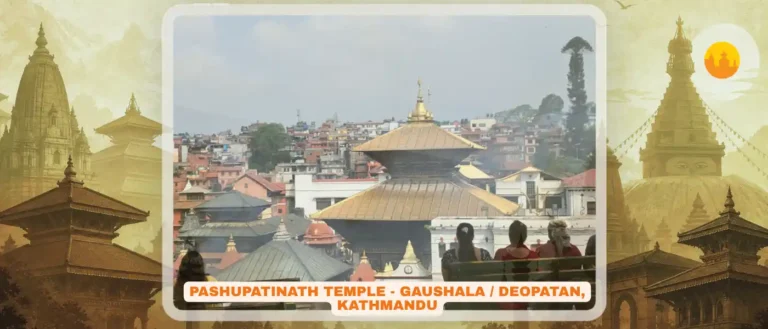
- Pashupatinath Temple, Gaushala/Deopatan, Kathmandu, Nepal
Flight to Tribhuvan International Airport (TIA) in Kathmandu; local taxi, prepaid airport taxi, private tourist vehicle, or local bus to Gaushala/Deopatan. Final approach involves a short walk through pedestrianized paths.
Strict vegetarian options and authentic Indian food are widely available in Gaushala and downtown Kathmandu. Avoid eating heavy meals immediately before walking or standing in long queues. Note that outside food, plastic water bottles, and leather items are prohibited inside the inner courtyard.
Generally flat walkways around the complex, but the main temple courtyard has stone steps, narrow passages, and lack of ramps. Wheelchair access is highly limited to peripheral pathways; the inner temple is inaccessible via wheelchair.
Watch out for aggressive rhesus macaques (monkeys) around the temple area and Slesh Mantak forest; keep food, flowers, and plastic bags concealed. Be vigilant against pickpockets in dense crowds. Do not photograph active cremations at the Aryaghat cremation platforms.
Kathmandu sits at an elevation of approximately 1,400 meters (4,593 feet) above sea level. This is well below the threshold for acute altitude sickness.



If you are coming to Nepal for Shiva darshan, Pashupatinath is the place your heart is already moving toward.
This is Lord Shiva as Pashupati, the lord of living beings.
The darshan can be powerful because the whole place carries that truth.
Around the temple, you see prayer and family devotion. You also see the Bagmati ghats, where life, death, mourning, and liberation stand close to each other.
Pashupatinath does not hide these things. It brings them into Shiva’s presence.
For Indian families, Pashupatinath is often the darshan that gives Nepal trip its spiritual center.
You may come before Muktinath. You may come after Muktinath. You may come only for Pashupati.
However you arrive, this is not a temple to rush through between hotel checkout and sightseeing.
Give it time. This ancient Shiva dham deserves your full attention.
Let your family enter slowly, take darshan, sit near the Bagmati, visit Guhyeshwari if possible, and return for the evening aarati if the day allows.
Pashupatinath is not only about reaching the sanctum. It is about feeling Kathmandu turn into a Shiva kshetra for a few hours.
This guide will help you plan that visit with confidence: when to go, what to expect, who can enter, how to include Bagmati aarati, how to care for elders, and which nearby dhams make sense with Pashupatinath.
Pashupatinath begins before the main darshan.
As you move into the Gaushala and Deopatan side of Kathmandu, the city slowly changes.
The road is still busy, but the temple area has its own pull. You begin to see pilgrims, sadhus, shops, flowers, bells, and people walking with the seriousness of darshan on their face.
Then the Bagmati appears.
That is when Pashupatinath becomes more than a temple visit. On one side, families move toward Shiva darshan. On another side, people sit quietly by the river.
Nearby, the ghats carry ancestral rites and cremation rituals. In the evening, lamps rise during the aarati and the sound of bells and chanting fills the riverbank.
This is why Pashupatinath feels so divine.
You are not only seeing a famous temple.
You are standing in a living Shaiva dham where Shiva is worshipped as the lord of all beings: the young, the old, the grieving, the hopeful, the wandering, the family pilgrim, the sadhu, the visitor, and the one who has come with no words left.
If you are used to large Indian temple towns, Pashupatinath may surprise you. It is not polished into one neat experience. It is raw, sacred, crowded in places, quiet in places, and deeply alive. That is its strength.
Pashupatinath is also much bigger than the main temple alone. The wider complex has many shrines, old temple spaces, ghats, paths, and layers of history around the Bagmati.
If you only come to the main gate, take darshan, and leave, you miss a large part of what makes Pashupati feel divine.
After you cross the Bagmati side, you can climb the stairs toward the forested area above the temple.
This quieter side gives a different Pashupati experience. The crowd softens, the air feels calmer, and you can spend a few peaceful minutes looking back toward the temple area. For many visitors, that small climb turns the visit from a darshan stop into a fuller sacred-place experience.
The best visit is not the fastest one.
The best visit is the one where you have time to take darshan, notice the Bagmati, sit for a few minutes, and let the place speak before you move on.
Keep half a day for Pashupatinath if this is your first visit.
A quick darshan can be done in less time on a normal day, but half a day gives your family space to enter, take darshan, walk around the Bagmati side, visit nearby shrines, and avoid rushing elders.
If you want the fuller experience, plan Pashupatinath in two parts:
Morning for main darshan.
Evening for Bagmati aarati.
If your family has time and energy, add Guhyeshwari Temple with Pashupatinath. The two belong naturally together in the Kathmandu pilgrimage experience.
This guide is for Indian pilgrims planning Pashupatinath as part of a real Nepal yatra.
You may be coming from Chennai, Bengaluru, Hyderabad, Kochi, Mumbai, Pune, Ahmedabad, Indore, Bhopal, Nagpur, Kolkata, Bhubaneswar, or another city where Nepal is a planned family pilgrimage, not a quick local visit.
You may be bringing parents for Shiva darshan. You may be combining Pashupatinath with Muktinath. You may be planning your first Kathmandu temple day and wondering what deserves time.
If that is you, keep Pashupatinath as a main experience, not a side stop.
Pashupatinath is dedicated to Lord Shiva as Pashupati.
Pashupati means the lord of living beings.
For a Hindu devotee, that name is not only a definition. It is the heart of the darshan. You come to Shiva who sees every living being: the body, the mind, the struggle, the attachment, the grief, the prayer, and the wish for freedom.
That is why the Bagmati side feels so important.
Pashupatinath does not separate devotion from real life. The temple bells, cremation ghats, family rituals, prayer spaces, and old shrines all sit in the same sacred area. The place reminds you that Shiva is present not only in celebration, but also in change, loss, release, and surrender.
The dham also carries deep Shaiva importance.
Pashupatinath is worshipped through the five-faced form of Shiva: Tatpurusa, Aghora, Sadhyojat, Vamdev, and Ishana.
Many Hindu traditions also place Pashupatinath inside a wider Himalayan Shaiva world, linked in memory with Kedarnath and other Shiva dhams.
You do not need to know every story before visiting.
But remember this much: when you go to Pashupatinath, you are not only going to “see a temple.” You are going for Pashupati darshan in one of the most important Shiva kshetras in Nepal.
Want to understand the dham more deeply before your visit? Read our full Pashupatinath Temple page.
The first-time plan is simple:
Reach Gaushala or Deopatan.
Enter the wider Pashupati area.
Go for main temple darshan if your group is eligible to enter.
Spend time around the Bagmati side and nearby shrines.
Visit Guhyeshwari if your family has time.
Return back or stay for the evening for Bagmati aarati.
Hindus may enter the main temple area. Non-Hindu visitors usually observe from nearby public areas across the Bagmati. If you are travelling with a mixed group, plan this before reaching the gate so nobody feels confused or disappointed on arrival.
For family darshan, morning is the best choice.
The temple area feels fresher, the day is easier to manage, and your family can continue to other Kathmandu dhams afterward. Morning also works better if you are travelling with parents or children.
Evening is for aarati.
The Bagmati aarati gives a different experience from main darshan. Lamps, bells, chanting, incense, and people sitting along the river create a public devotional atmosphere. If your schedule allows it, do not miss it.
For Shiva devotees, Maha Shivaratri is the biggest time at Pashupatinath. Shravan Mondays, Teej, and major Shiva observances also bring strong devotional movement.
These days carry power, but they also bring crowds.
If this is your family’s first Pashupatinath visit, choose a normal weekday morning for calmer darshan. If you want the energy of a major Shiva day, keep extra time and do not plan anything tight around it.
Use the TirthGo Trip Planner to check upcoming tithi, festival, and deity-day timing before finalising your visit.
Expect a living temple area, not a controlled sightseeing zone.
There may be queues, security checks, temple instructions, small shrines, sadhus, families, local devotees, tourists in the public areas, and changing crowd movement depending on the day.
The Bagmati ghats are active ritual spaces. You may see cremation rites or ancestral rituals. Move respectfully. Do not photograph private grief. Do not make the ghats a background for casual pictures.
Photography is not allowed inside the main temple complex. Shoes, leather items, and cameras are also restricted inside the main complex. Carry only what you need and follow the instructions given on the day.
On a normal morning, Pashupatinath can feel manageable for families. On Maha Shivaratri, Teej, Shravan Mondays, and other busy days, the same area can become crowded, slow, and tiring.
How To Reach Pashupatinath In Kathmandu
Pashupatinath is in the Gaushala / Deopatan area of Kathmandu.
For Indian families, the simplest option is a taxi or private vehicle from the hotel. Local transport is available, but if you are travelling with elders, children, or fixed timing, keep the movement simple.
Hotels and guesthouses are also available around the Pashupatinath / Gaushala area. If you stay nearby, walking to the dham may be enough, especially for morning darshan or evening aarati.
This can make the visit easier if your family wants to avoid depending on Kathmandu traffic for every temple movement.
If you are staying farther, Kathmandu traffic can change quickly. Keep buffer time if you are visiting before a flight, hotel checkout, or another fixed plan.
How Much Time To Keep
For basic darshan, keep at least 2 to 3 hours including hotel travel, walking, entry, darshan, and a little time around the temple area.
For a better first visit, keep half a day.
That gives you time for darshan, the Bagmati side, nearby shrines, Guhyeshwari, and a slower pace with elders.
If you want to include evening aarati, plan the day in two parts: morning darshan and evening aarati.
This works better than trying to force everything into one rushed visit.
Entry And Temple Rules
The main temple is open only to Hindus. Non-Hindu visitors usually observe from the opposite side of the Bagmati and other public areas.
Dress modestly. Keep your visit simple. Avoid carrying unnecessary bags. Do not take leather items, cameras, or photography expectations into the main temple complex.
If you are unsure about a rule, ask before acting.
Pashupatinath is a living temple, and small restraint keeps the visit respectful.
Pashupatinath is easier than high-altitude yatras like Muktinath or Gosainkunda. It is in Kathmandu, and many elders can visit comfortably with a thoughtful plan.
Still, do not underestimate the visit.
Crowds, queues, steps, long standing, sun, rain, and traffic around Gaushala can tire elders quickly. Choose a quieter time, keep water nearby, avoid a packed schedule, and let your parents sit when needed.
If your family wants evening aarati, arrive early enough to find a comfortable place. Do not drag elders into a thick crowd at the last minute.
Pashupatinath rewards a slower visit. Let your family take darshan properly.
The evening aarati by the Bagmati is one of the strongest reasons to give Pashupatinath more than a quick darshan slot.
This is not the same as entering the main temple. It is a shared devotional gathering by the river. Lamps rise, bells ring, incense moves through the air, and people sit together as Kathmandu turns toward evening.
For many families, this is the moment they remember most clearly.
If your visit allows only one extra experience after main darshan, choose the aarati. It shows the public devotional life of Pashupati in a way a quick temple entry cannot.
Check the local timing on the day.
Weather, crowds, festivals, and local arrangements can affect where you can sit or stand.
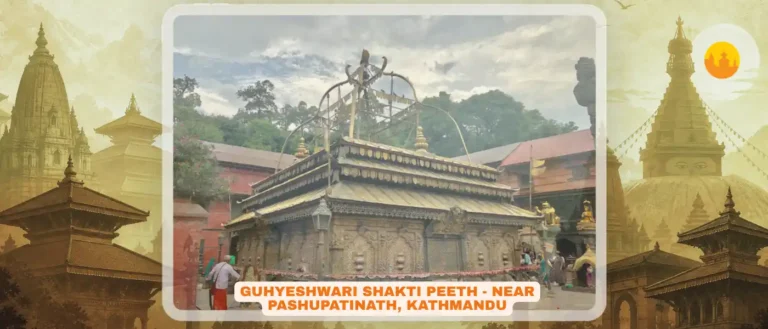
Guhyeshwari Temple
Guhyeshwari is the most natural dham to combine with Pashupatinath.
If Pashupatinath gives you Shiva darshan, Guhyeshwari brings the Shakti side of the same sacred area into the visit. In Hindu tradition, Shiva and Shakti are not separate in feeling. Pashupati and Guhyeshwari together give the pilgrim a fuller sense of this sacred Kathmandu space.
The Pashupati area also carries story memory from Swasthani Brata Katha. In that tradition, Shiva’s presence in the Pashupati area is tied with the Slesh Mantak forest and the deer story remembered around the dham.
Guhyeshwari brings the Sati-Shakti thread into the same pilgrimage space. So when you visit both, you are not just adding a nearby temple. You are moving through the Shiva and Shakti story of the area.
If your family has time, do not skip it casually.
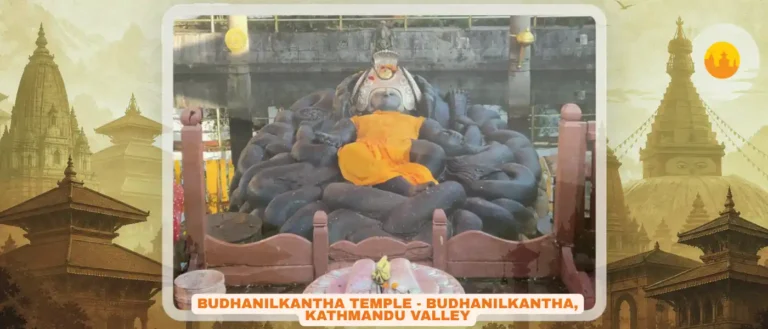
Budhanilkantha
Budhanilkantha can be added on a Kathmandu temple day if your family wants Vishnu darshan in the same city.
It is not next door to Pashupatinath, so plan transport and timing properly.
Muktinath
If your Nepal trip includes Muktinath, Pashupatinath can be your opening or closing darshan in Kathmandu.
Many Indian families like the combination: Shiva darshan at Pashupatinath and Vishnu darshan at Muktinath. Give both enough space so the trip does not become only transport and hotel movement.
Maha Shivaratri is the biggest event at Pashupatinath. The whole area changes during this period. The devotion is powerful, but the crowd can be heavy.
Teej is also important, especially for women devotees. Shravan Mondays bring strong Shiva worship and more movement than ordinary days.
Festival visits need a different plan from normal darshan. Keep more time, carry less, avoid tight schedules, and be honest about what elders can manage.
Use the TirthGo Trip Planner to check upcoming tithi, festival, and deity-day timing before deciding your travel date.
Do not treat Pashupatinath as a quick photo stop.
Do not arrive too close to flight time or hotel checkout.
Do not assume everyone in your group can enter the main temple.
Do not carry unnecessary bags, cameras, or leather items into the main temple area.
Do not photograph cremation rites or private family rituals.
Do not push elders into festival crowds if they need calmer darshan.
Do not skip Guhyeshwari if your family has time and wants a fuller Shiva-Shakti visit.
How much time is needed for Pashupatinath darshan?
Keep at least 2 to 3 hours for a basic visit. Keep half a day if you want main darshan, time by the Bagmati, nearby shrines, Guhyeshwari, and a slower family pace.
What is the best time to visit Pashupatinath?
Morning is usually best for normal darshan. Evening is best if you want to experience the Bagmati aarati. Maha Shivaratri, Teej, and Shravan Mondays are powerful but crowded.
Can Indian pilgrims enter Pashupatinath Temple?
Hindu pilgrims can enter the main temple area. The main temple complex has entry restrictions, and non-Hindu visitors usually observe from nearby public areas across the Bagmati.
Is Pashupatinath suitable for elderly pilgrims?
Yes, many elders can visit Pashupatinath with a careful pace. Avoid peak crowd times, keep the schedule light, and give them time to sit and rest.
Can we attend the Bagmati aarati?
Yes, visitors can usually witness the evening aarati from the Bagmati side. Check the local timing on the day because crowds, weather, and arrangements can change the experience.
Is photography allowed inside Pashupatinath?
Photography is prohibited inside the main temple complex. Also avoid photographing cremation rites and private rituals around the ghats.
Can we combine Pashupatinath and Guhyeshwari?
Yes. Guhyeshwari is one of the best nearby dhams to combine with Pashupatinath, especially if your family wants a fuller Shiva-Shakti visit in Kathmandu.
Can we combine Pashupatinath and Muktinath in one Nepal trip?
Yes. Pashupatinath and Muktinath are one of the strongest Nepal pilgrimage combinations for Indian devotees. Keep enough days so the trip does not feel rushed.
Do we need a guide for Pashupatinath?
You can visit on your own, but a good local guide or trusted travel partner can help with route flow, temple rules, Guhyeshwari combination, aarati timing, and family comfort.
Where can I check Shiva festival dates for Pashupatinath?
Use the TirthGo Trip Planner to check upcoming tithi, festival, and deity-day timing before finalising your visit.
Want to go on a teerth yatra to Nepal? Contact TirthGo on WhatsApp.
Message TirthGo first for route guidance, community updates, and help connecting with a trusted travel partner only when you ask for trip support.
TirthGo may connect interested pilgrims with independent travel partners and may earn a referral commission if a booking happens.